Competitor Product Analysis: Find What You're Missing
Competitor product analysis reveals the revenue hiding in your catalog gaps. Find products your competitors carry that you're missing — and act on them.

Why Competitor Product Analysis Reveals Hidden Revenue
To find products your competitors sell that you don't, use competitor product analysis: cross-reference your catalog against competitors' catalogs to surface the gaps. Automated platforms can do this instantly across thousands of products. Manual approaches — browsing competitor sites and comparing against your own inventory — work for small catalogs but break down fast. Five competitors with 500 products each means 2,500 products to review by hand.
Most retailers who track competitor prices focus on a single question: "How do my prices compare on the products we both sell?" That's useful — but it's only half the picture.
The other half is the gap. The products your competitors carry that aren't in your catalog at all. Products that their customers buy, that your customers might also want, that you've never considered stocking because you didn't know there was demand.
This is competitor gap analysis, and in our analysis of 82 price monitoring tools, automatic product discovery was the most-requested feature — yet only Keepa (Amazon-only) and SellWisely (cross-retailer) offer it.
Automatic Discovery Is Rare Only Keepa and SellWisely offer automatic product discovery — most tools require you to manually add every competitor URL.
Why Gap Analysis Matters More Than Price Comparison
Price comparison helps you protect existing revenue. Gap analysis helps you find new revenue.
Two Different Problems Gap analysis finds new revenue opportunities; price comparison protects existing revenue. You need both.
Consider the math. If you track prices on 200 products you share with a competitor, and you discover you're 5% overpriced on 30 of them, adjusting those prices might recover some lost margin. That's valuable — maybe a few thousand dollars per month.
But if that same competitor carries 80 products you don't sell at all, and 20 of those are in categories where you already have supplier relationships, adding those 20 products to your catalog creates entirely new revenue. That's not margin recovery. That's growth.
There are three specific reasons gap analysis is underused:
It's invisible unless you look for it. Price comparison tools show you what's in both catalogs. They don't show you what's in one catalog and not the other. You can't manage what you don't measure, and most retailers literally can't see the gap.
Manual gap analysis is impractical. Browsing a competitor's entire website, noting every product, and comparing it against your own catalog product-by-product is a multi-day exercise. For competitors with thousands of SKUs, it's impossible to do thoroughly by hand.
Until recently, no tool did this well. Automatic product discovery — the ability to find products without the user specifying what to look for — is the top feature request in Prisync reviews on Capterra. Keepa offers something close, but only for Amazon products. For cross-retailer gap analysis, the pre-collected data model is the first approach that makes it practical at scale.
The Manual Approach (And Why It Tops Out Quickly)
If you want to do gap analysis manually, here's how it works in practice:
- Pick your top 3–5 competitors
- Browse each competitor's category pages — electronics, home goods, accessories, whatever matches your store
- For each product they carry, check whether you carry it too
- Track the gaps in a spreadsheet: product name, competitor, price, category
- Repeat every month or quarter to catch new additions
This is doable for a small catalog. If your competitor carries 100 products and you carry 80, you can manually identify the 20-product gap in a few hours. But the effort scales linearly:
- 3 competitors with 200 products each = 600 products to review
- 5 competitors with 500 products each = 2,500 products to review
- 10 competitors with 1,000 products each = you're not doing this manually
The bigger problem is recency. Manual gap analysis gives you a snapshot, not ongoing monitoring. Your competitor adds 15 new products next month. Unless you repeat the entire exercise, you won't know.
And manual browsing can't catch products that aren't prominently displayed. Clearance items, new arrivals buried in subcategories, products that only appear in search results — you'll miss these unless you're exhaustively crawling every page.
Manual vs Automated Gap Analysis
| Factor | Manual Browsing | Automated (Pre-Collected) |
|---|---|---|
| Time per analysis | Days to weeks | Seconds |
| Products reviewed | Hundreds (practical max) | Millions |
| Coverage | Only what you can see browsing | Full catalog including search-only items |
| Frequency | Quarterly at best | Continuous |
| Cost | Staff time (hours) | $0–$99/month |
| Finds hidden products | No | Yes |
Automated Gap Analysis: What's Now Possible
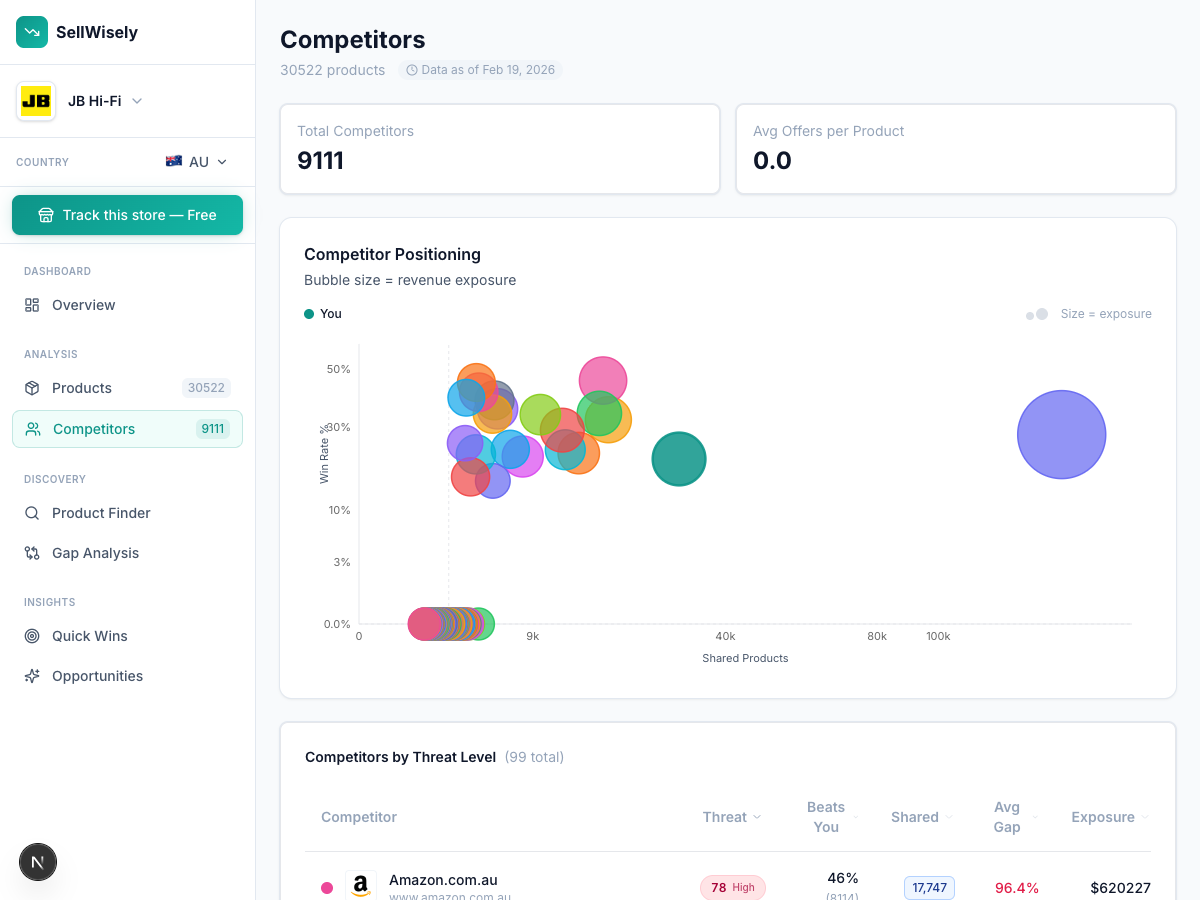
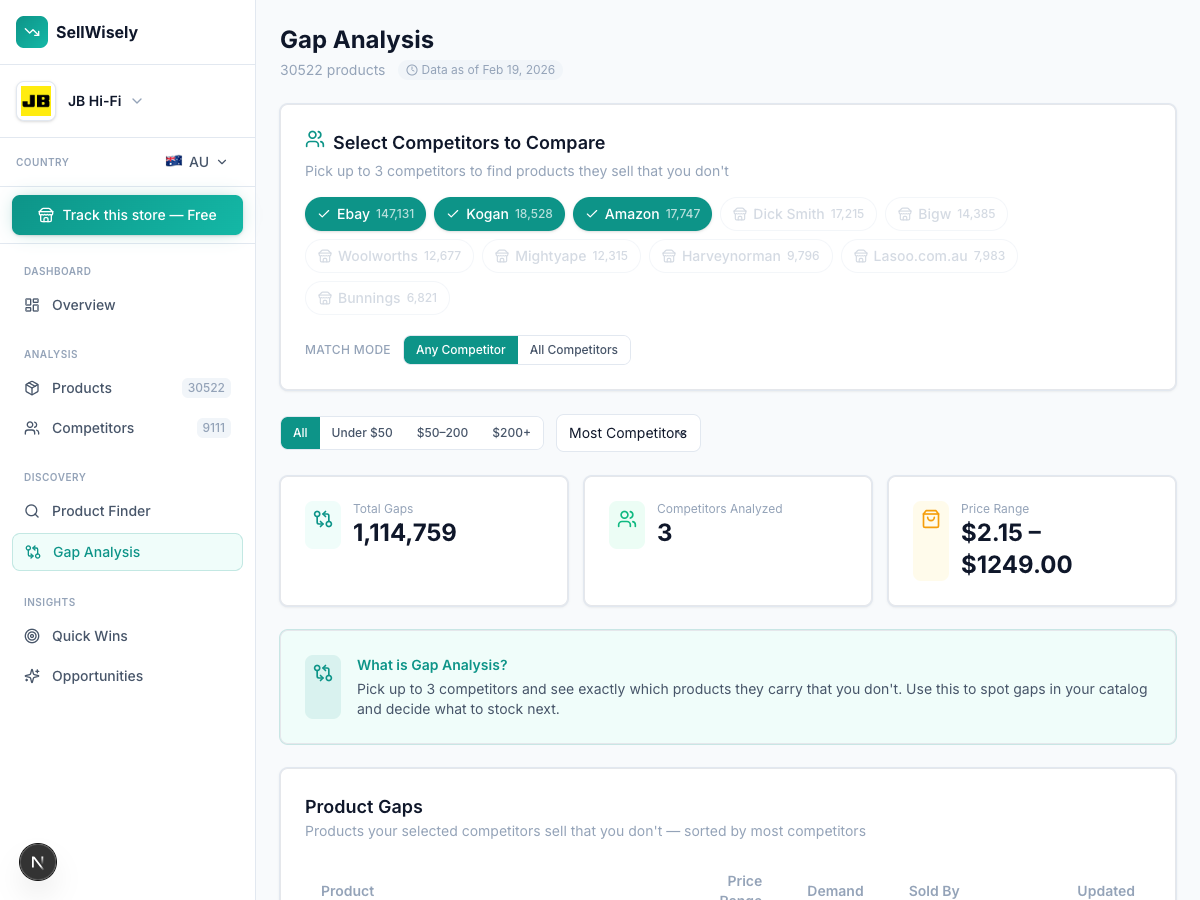
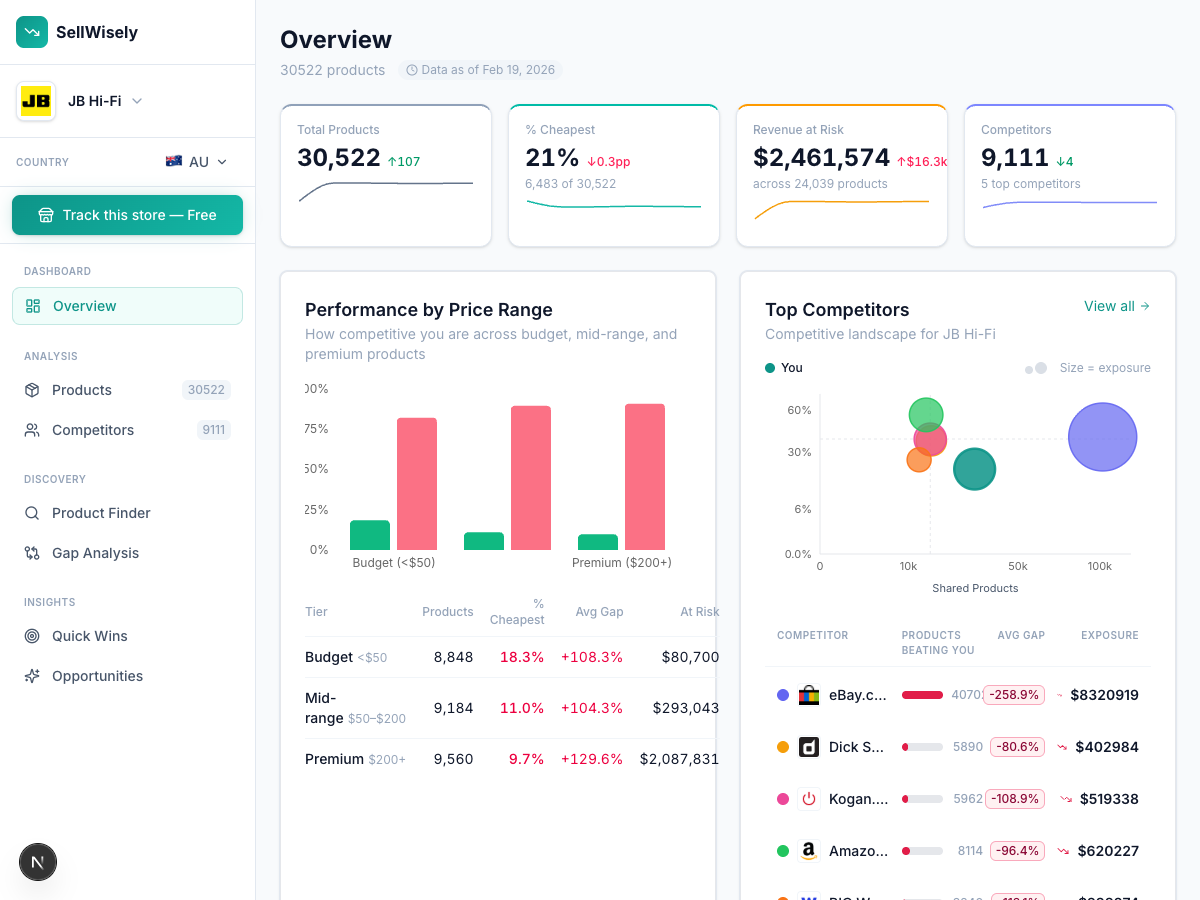
The pre-collected data model that platforms like SellWisely use changes the gap analysis equation entirely. When a platform has already indexed millions of products across thousands of retailers, comparing any two catalogs becomes a database query, not a manual research project.
The automated approach:
Step 1: Select your competitors. You pick the retailers you want to compare against — whether that's 3 competitors or 30. The platform already knows their full product catalogs because it's been collecting that data continuously.
Step 2: See the gap instantly. The platform cross-references your product catalog against each competitor's. Products that appear in their catalog but not yours surface immediately. No browsing, no spreadsheets, no multi-day research.
Step 3: Filter and prioritize. Not every gap product is worth pursuing. Filter by category, price range, or the number of competitors carrying the product. A product that all five of your top competitors carry but you don't is a stronger signal than one carried by a single niche competitor.
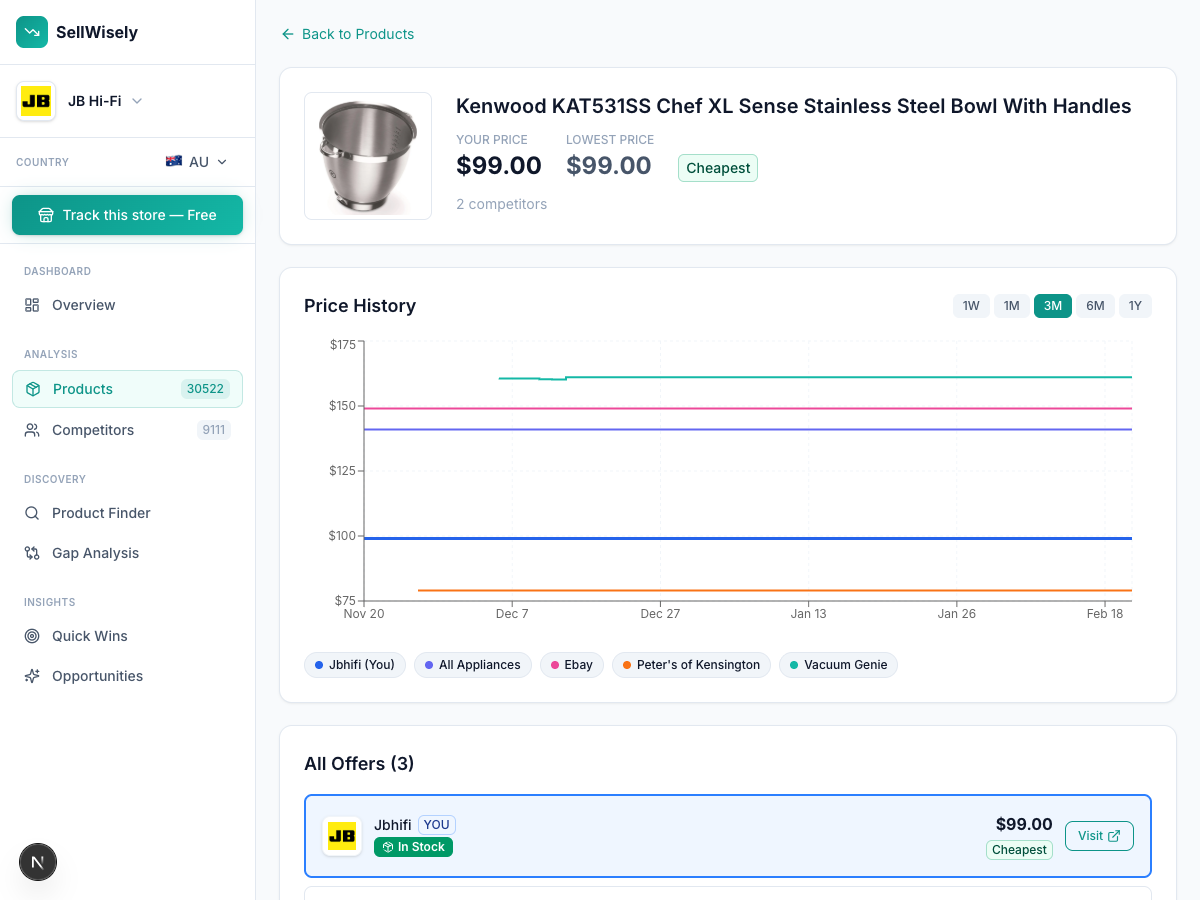
Step 4: Evaluate the opportunity. For each gap product, you can see which competitors sell it, at what prices, and how those prices have changed over time. This tells you whether there's a stable market for the product or whether it's a one-off clearance item.
What to Look For in Gap Analysis
Not all product gaps are equal. Some are high-signal revenue opportunities. Others are noise.
- Look for items carried by 3+ competitors. If three out of your five tracked competitors all carry the same item that you don't, there's probably demand for it. Single-competitor products could be an experiment or a supplier-specific exclusive.
- Stick to categories you already serve. A gap product in a category where you already have supplier relationships is easy to add. A gap product in a completely new category might require new supplier negotiations, different warehousing, or unfamiliar marketing — higher friction, higher risk.
- Stability matters — check price history. Consistent pricing over months suggests steady demand. Rapidly declining prices might indicate a product that's being discontinued or replaced by a newer model.
- Out-of-stock items seem counterintuitive, but they're gold. Why stock something competitors can't keep in stock? Because it means demand exceeds supply. If you can source the product reliably, you'll pick up customers that your competitors are failing to serve.
- Think about cross-sell opportunities. If you sell cameras, and your competitors also sell camera bags, tripods, and memory cards that you don't carry, those gap products are natural cross-sells that could increase average order value.
What to Ignore
Exclusive or white-label products. If a competitor sells something under their own brand name that has no equivalent from other manufacturers, it's not a gap you can fill.
Products far outside your category. A competitor that sells both electronics and kitchenware isn't signaling that you should diversify from electronics to kitchenware. Focus on gaps within your existing product categories.
Deep discount or liquidation items. Competitors occasionally carry products at steep markdowns to clear inventory. These aren't growth opportunities — they're one-time events.
Products with thin margins in your market. Even if competitors carry a product, that doesn't mean it's profitable for them. Cross-reference gap products against your supplier pricing to ensure viable margins before committing inventory.
Turning Gap Insights Into Action
Identifying gaps is the analytical part. Deciding what to do with them is the strategic part. A practical framework:
Quick wins — add within 2 weeks: Products you can source from existing suppliers, in categories you already serve, with clear demand signals (multiple competitors carry them). These should go straight into your ordering system.
Evaluate — research over 30 days: Products that require new suppliers or fall in adjacent categories. Run the numbers: what's the expected margin? What's the minimum order quantity? Can you test with a small batch before committing to full inventory?
Watch — monitor quarterly: Products in categories you don't currently serve. Track whether competitor coverage expands or contracts over time. If a product you're watching gets picked up by additional competitors over successive quarters, the demand signal strengthens.
Skip — not worth pursuing: Exclusive products, thin-margin items, categories that don't align with your brand positioning. Document why you skipped them so you don't re-evaluate the same products every cycle.
Example: A Walkthrough of Discovery to Decision
Imagine you run a mid-sized electronics retailer carrying 400 products. You set up gap analysis against five competitors: JB Hi-Fi, The Good Guys, Harvey Norman, Bing Lee, and Officeworks.
The analysis reveals 120 products across those competitors that you don't carry. That sounds like a lot, but most will be noise. Apply the filters:
- Carried by 3+ competitors: 45 products remain
- In your existing categories: 32 products remain
- Stable pricing (not being discontinued): 28 products remain
- Available from your existing suppliers: 18 products remain
Now you have 18 specific product opportunities with clear demand evidence. You can see exactly what each competitor charges, identify a competitive price point, and estimate margin from your supplier costs.
That's a gap analysis that would have taken a week of manual browsing, completed in the time it takes to apply a few filters.
The Filtering Funnel 120 gap products typically narrow to 18 actionable opportunities after filtering by demand, margin, and relevance.
Why This Matters Now
Product discovery through gap analysis has been one of the most requested features in the competitive intelligence space. It's also been one of the hardest to deliver, because it requires knowing the full catalog of every retailer you want to compare against — not just the specific products a user configured for tracking.
This is why the pre-collected data model is a prerequisite for effective gap analysis. Traditional tools only know about the products you explicitly added. They can't show you what you're missing because they only see what you told them to look for.
SellWisely's database covers 5M+ products across 10,000+ retailers. That's enough product coverage to run meaningful gap analysis across most retail categories, from electronics to home goods to sporting equipment.
For a broader look at how competitor tracking fits into your pricing strategy, see our guide to tracking competitor prices. And if you're evaluating tools for the job, read our comparison of the best price monitoring tools.
What products are your competitors selling that you're not? Enter your store URL into SellWisely and find out — free, in seconds.
Ready to track your competitors' prices?
Enter your store URL and see competitor prices instantly. No signup required.
Try SellWisely Free