Best Price Monitoring Tools in 2026
The best price monitoring tools in 2026, ranked after profiling 82 competitors and analyzing 1,300+ reviews. Real pricing, setup times, and honest verdicts.
Best Price Monitoring Tools: What Actually Matters in 2026
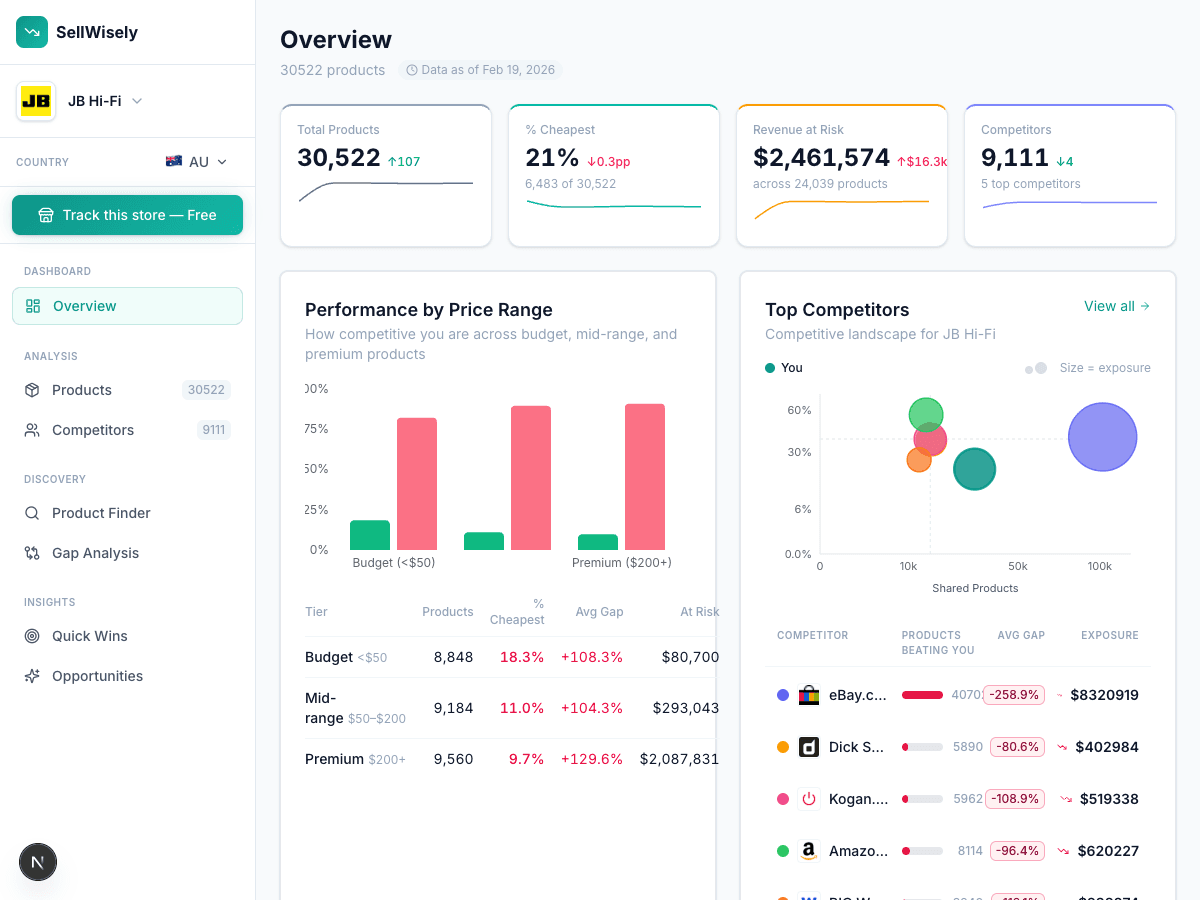
The best price monitoring tools in 2026, based on our analysis of 82 competitors and 1,300+ customer reviews: SellWisely (best for zero-setup, free tier), Prisync (best for established SMBs), Price2Spy (best support and cheapest entry), Keepa (best for Amazon), and four more options ranging from DIY platforms to enterprise AI.
The Research Behind This Guide 82 competitors analyzed, 1,300+ customer reviews studied across every major platform.
Quick picks by use case:
- Just want competitor prices now, no setup: SellWisely (free, 10 seconds to data)
- Proven platform, don't mind CSV setup: Prisync ($99/mo, 4.8/5 Capterra)
- Amazon FBA seller: Keepa (free browser extension, paid from €19/mo)
- Technical team, want to build custom: n8n (free self-hosted) or Apify ($49/mo)
- Enterprise with 5,000+ SKUs: Competera ($500+/mo, AI-driven)
We evaluated each on the criteria that actually matter: how fast can you get data, what does it cost month-to-month, and what happens when you grow from 50 to 500 products? No "request a demo" black boxes — only tools with published pricing or free tiers made the cut.
1. SellWisely
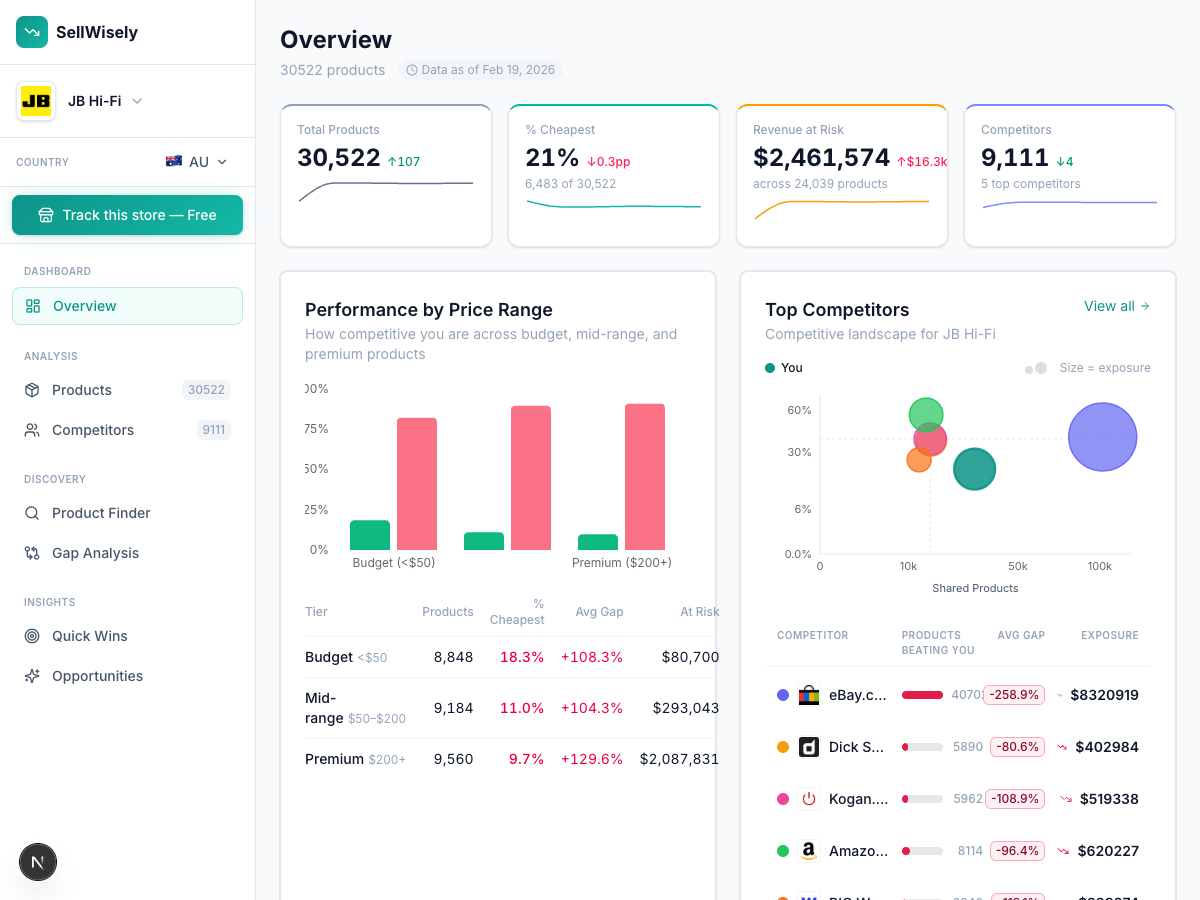
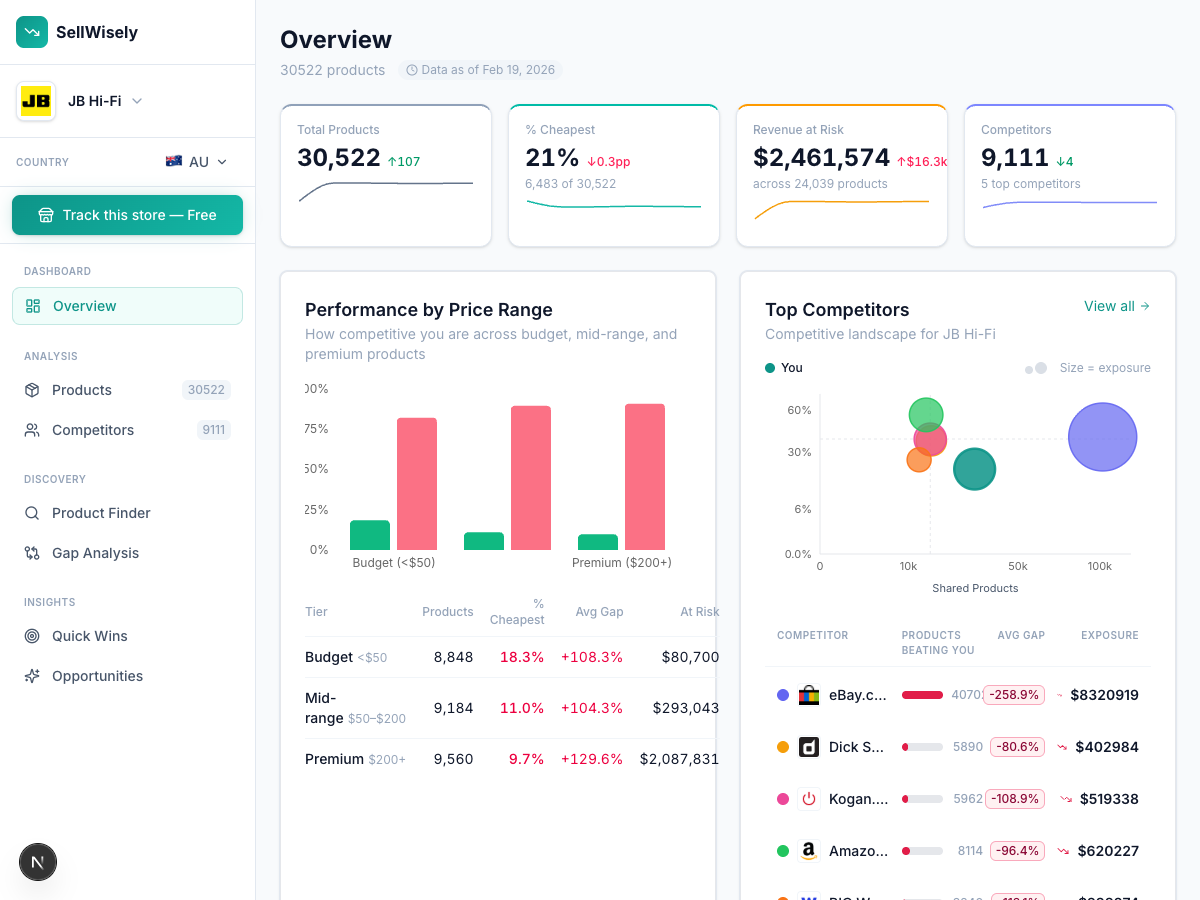
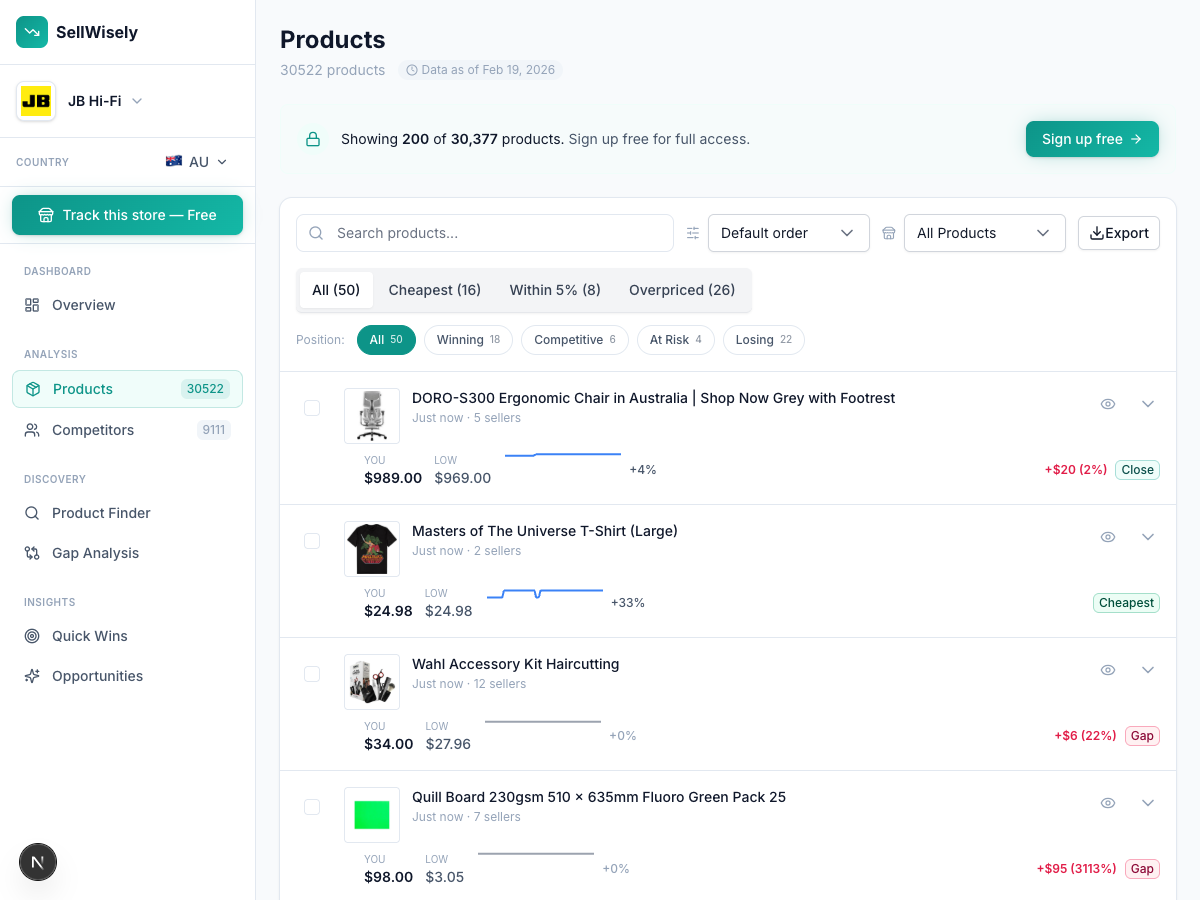
Every other tool on this list starts with an empty database when you sign up. SellWisely starts with 3 years of data and 5 million products already indexed — the same model Keepa uses for Amazon, except SellWisely works across thousands of retailers, not just one marketplace. Enter your store URL, and it instantly shows you who's selling the same products and at what price. No CSV uploads, no competitor URL mapping, no waiting for an initial crawl.
Pricing: Free tier (50 products, forever free, no credit card) or Pro at $99/month (500 products, API access, hourly updates, 3-year history).
Best for: Retailers who want competitor prices without spending a single minute on setup. The pre-collected data model means you discover competitors you didn't even know existed.
Where it falls short: SellWisely is the newest tool on this list, and it shows in a few ways. Coverage is deepest in Australia, with global expansion underway — niche DTC brands may not be in the index yet. There are no customer reviews on Capterra or G2 to independently verify claims (compare that to Prisync's 130 reviews). No Shopify app integration yet (see our Shopify price monitoring guide for alternatives). And the pre-collected model means data freshness depends on SellWisely's crawl schedule rather than on-demand scraping, which may lag for fast-changing prices.
2. Prisync
What it does: Prisync is the established leader in SMB price monitoring, and for good reason. Founded in 2013, they've processed millions of price points for 600+ customers across 50+ countries. The platform tracks competitor prices, stock availability, and offers dynamic pricing rules on higher tiers.
Pricing:
- Professional: $99/month (250 URLs, daily email reports)
- Premium: $259/month (1,000 URLs, instant alerts)
- Platinum: $399/month (2,500 URLs, 1-year history, dynamic pricing)
- API access costs an additional 20% on any tier
Best for: Mid-market retailers (100–2,000 SKUs) who want a proven platform with excellent customer support. Prisync's 4.8/5 Capterra rating across 130 reviews isn't a fluke — their support team is consistently praised.
Limitations: Setup requires CSV mapping and manual URL entry. In our review analysis, 70% of negative reviews cited setup friction as the primary complaint. "Initial setup was a lot of work" appears repeatedly. Historical data is limited to 1 year and only on the most expensive Platinum tier. The Shopify app (4.9/5, 202 reviews) offers a faster setup path, but you still need to define your competitors and map products.
Bottom line: If you have 2–8 hours to invest in setup and want an established platform, Prisync delivers solid data. Just know that the per-URL pricing model means costs scale linearly with your catalog.
3. Price2Spy
What it does: Price2Spy is a managed-service-oriented price monitoring tool with surprisingly deep features. They've been in the market since 2011, serve 750+ customers, and have a perfect 5.0/5 support rating on Capterra. Their AutoMatch feature helps with product discovery, and they offer built-in repricing capabilities.
Pricing:
- Starter: $39.95/month (500 URLs)
- Professional: $78.95/month (1,000 URLs)
- Premium: $157.95/month (2,000 URLs, API access, multi-user)
- Enterprise: custom pricing
Best for: Retailers who value hands-on support and managed setup. Price2Spy's team will help you configure products — a real advantage if you don't want to figure out CSV mapping yourself. Their repricing engine is also included at no extra cost.
Limitations: The "managed" approach cuts both ways. You can't upload products yourself without going through their support team. Several reviewers flagged "can't self-upload products" as a frustration. Price updates can be slow compared to Prisync's 3x daily cadence. The interface feels dated compared to newer tools.
Bottom line: The cheapest entry point among dedicated SaaS tools at $39.95/month, and the support quality is genuinely best-in-class. If you're willing to work through their team for setup, the value is strong.
4. Keepa
If you sell on Amazon, you probably already have this installed. Keepa's browser extension (4 million+ installs) embeds price history charts directly into Amazon product pages, and the paid tier's Product Finder lets you filter by sales rank, FBA fees, buy box status, and seller count to find sourcing opportunities. 5 billion+ products tracked across 11 Amazon marketplaces, with complete price history going back years.
Keepa's Scale Keepa tracks 5 billion+ products with 4 million+ browser extension installs — but only covers Amazon.
Pricing: Free browser extension (price charts + basic alerts) forever. Paid: €19/month or €189/year for Product Finder, data exports, and advanced filters. API access: €100–€2,000/month.
Best for: Amazon FBA sellers and anyone who needs deep Amazon competitive intelligence. The Product Finder is genuinely useful for product sourcing — filter by "Amazon out of stock + low seller count + high demand" to find arbitrage opportunities.
The catch: Amazon only. Keepa explicitly does not support many regional Amazon marketplaces. It can't track eBay, Shopify stores, or any independent retailer. If you sell across multiple channels, Keepa covers just one of them — see our guide on price monitoring beyond Amazon for multi-channel alternatives. There's also essentially no customer support — emails go unanswered according to user reports. Unbeatable for Amazon, but you'll need something else for everything outside it.
5. Browse AI
Browse AI turns web scraping into a point-and-click exercise. You "train" a robot by clicking on the data you want to extract from any website — product name, price, availability — and it handles the scraping on a schedule. 4 million Chrome installs and 500,000+ users confirm the setup experience works.
Pricing: Free (50 credits/month, enough for 5–10 products daily), Starter $39/month (2,000 credits), Professional $99/month (6,000 credits), Enterprise custom.
Best for: Retailers who need data from websites that dedicated tools don't cover — niche competitors, regional retailers, specialty marketplaces. No coding required.
The gap between scraping and intelligence: Credit-based pricing creates anxiety at scale — daily monitoring of 100 products across 5 competitors burns through 6,000 credits fast. Robots break when websites redesign. And crucially, Browse AI provides raw data extraction, not price intelligence. No product matching, no trend analysis, no competitive insights. You get a spreadsheet of scraped prices and you're on your own from there. Calling it "price monitoring" is generous — it's a scraping tool you can build price monitoring on top of.
6. Apify
What it does: Apify is a developer-focused web scraping and automation platform. It runs pre-built "Actors" (scraping scripts) for common targets like Amazon, Google Shopping, and e-commerce sites, or you can build custom Actors for any website. It's powerful, flexible, and geared toward people comfortable with APIs and code.
Pricing:
- Free: $5/month in platform credits (enough for light usage)
- Starter: $49/month
- Scale: $499/month
- Enterprise: $999/month
Best for: Technical teams who want maximum flexibility and don't mind writing code. If you have a developer on staff and need to scrape data from 50 different sources, Apify gives you the building blocks.
Limitations: The learning curve is steep. Actors break when target websites update their layouts — the top complaint in Apify's Trustpilot reviews (4.0/5 across 378 reviews). There's no product matching intelligence; you get raw scraped data and need to build your own comparison logic. Credit-based pricing makes costs hard to predict.
Bottom line: Excellent scraping platform, mediocre price monitoring solution. The gap between "I can scrape competitor prices" and "I have actionable pricing intelligence" is larger than most teams expect.
7. n8n
n8n is not a price monitoring tool — it's an open-source workflow automation platform (think Zapier but self-hostable and developer-friendly). It appears on this list because the community has built 10+ price monitoring workflow templates that connect scraping tools (Bright Data, Apify, HTTP requests) to Google Sheets or databases. With 500,000+ users and $40 million ARR built on zero paid advertising, the community is large and helpful.
Pricing: Self-hosted is free forever (requires your own server). Cloud: €24/month Starter (2,500 executions), €60/month Pro (10,000 executions), €800/month Enterprise.
Best for: Technical teams who enjoy building and maintaining custom workflows and want maximum control over their data pipeline.
Reality check: You're building a price monitoring system from scratch. Initial setup takes 5–10 hours. Workflows break when target websites change layouts — expect 12–36 hours per year in maintenance. The 10,000 execution cap on Pro limits you to roughly 50–100 products with daily monitoring. No product matching, no historical analysis, no intelligence layer — just raw data piped into spreadsheets. n8n itself is excellent. Using it for price monitoring is like building your own car instead of buying one — deeply satisfying for the mechanically inclined, increasingly painful as complexity grows.
If you're considering the DIY route, read our analysis of whether building your own price monitoring is worth it.
8. Competera
What it does: Competera is the enterprise end of the price monitoring spectrum. Their AI-powered platform combines competitive data, demand sensing, and price optimization for large retailers. We're talking 930+ AI models, real-time data feeds, and pricing recommendations designed for catalogs of 5,000 to 100,000+ SKUs.
Pricing:
- Entry: approximately $500–$6,000/month
- Mid-market: $50,000+/month
- Enterprise: $100,000+/month
- No free tier, no self-serve signup
Best for: Large retailers ($50M+ revenue) with dedicated pricing teams. Competera's clients include Walmart, Samsung, and other Fortune 500 names. The AI-driven pricing recommendations reportedly deliver 50–80% reduction in pricing workload.
Limitations: Completely inaccessible to SMBs. The entry price starts around $500/month and scales to six figures annually. Implementation takes 60+ days with dedicated consultants. You need to provide 2+ years of your own historical data at signup. This is a tool for companies with pricing directors, not store owners.
Bottom line: If you're processing tens of thousands of SKUs and your competitors include Fortune 500 retailers, Competera is worth the conversation. Everyone else should look elsewhere.
Master Comparison Table
| Tool | Setup Time | Monthly Cost | Free Tier | Product Matching | Retailer Coverage | API | Mobile App |
|---|---|---|---|---|---|---|---|
| SellWisely | 10 seconds | $0–$99 | Yes (50 products) | Automated (90%+) | 10,000+ retailers | Yes (Pro) | No |
| Prisync | 2–8 hours | $99–$399 | No (14-day trial) | ML + manual CSV | Any website (user-configured) | Yes (+20% cost) | No |
| Price2Spy | 3–10 hours | $39.95–$157.95 | No (14-day trial) | AutoMatch | 110,000+ websites | Yes (Premium) | No |
| Keepa | 0 seconds | Free–€19 | Yes (forever free) | ASIN-based (100%) | Amazon only (11 markets) | Yes (€100+) | Yes |
| Browse AI | 10–30 min | $0–$99 | Yes (50 credits) | None | Any website (robot training) | Yes | No |
| Apify | 30 min–2 hours | $0–$499 | Yes ($5 credits) | None | Any website (Actor-based) | Yes (core) | No |
| n8n | 5–10 hours | Free–€60 | Yes (self-hosted) | None | Any website (DIY workflow) | Yes (core) | No |
| Competera | 60+ days | $500–$100K+ | No | AI (98%+ SLA) | Managed scraping | Yes | No |
How to Choose: A Decision Framework
Start with your product count:
- Under 30 products: Google Sheets is honestly fine. ImportXML works, and you're not spending enough time to justify a paid tool. Revisit when your spreadsheet starts breaking.
- 30–100 products: This is where spreadsheets become painful but enterprise tools are overkill. SellWisely's free tier handles 50 products with zero setup. Prisync or Price2Spy work if you prefer established platforms and don't mind the initial configuration.
- 100–500 products: You need a real tool. The question is whether you value setup speed (SellWisely) or established track record (Prisync/Price2Spy). DIY approaches start breaking at this scale.
- 500+ products: Prisync's higher tiers, SellWisely Pro, or — if you're approaching 5,000+ SKUs — start looking at Competera and enterprise options.
Then consider your technical skills:
- If you can write code and enjoy building systems, n8n or Apify might scratch that itch. But honestly? After analyzing 1,300+ reviews, the pattern is universal: DIY price monitoring works for about 6 months before maintenance fatigue sets in. The first weekend you spend 8 hours debugging a broken scraper is when most teams switch to a dedicated tool.
And your channel mix:
- Amazon-only seller? Keepa is unbeatable and basically free.
- Multi-channel seller (Amazon + eBay + your website + marketplaces)? You need a tool that covers all your channels in one dashboard. Keepa explicitly can't do this.
What We Learned From 1,300+ Reviews
Three complaints dominate across every tool we analyzed:
-
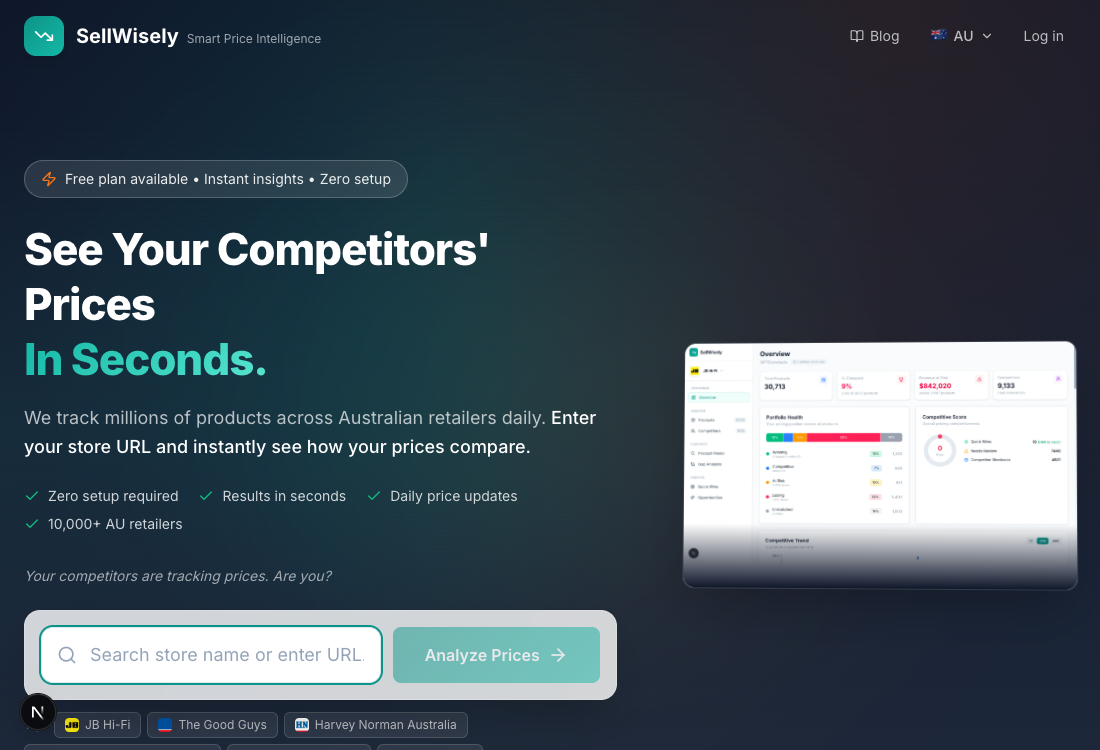
Setup friction (70% of negative reviews): Users expect data in minutes, not days. CSV mapping, URL configuration, and "onboarding processes" frustrate buyers who just want to see competitor prices.
-
Data accuracy (40–50% of negative reviews): Scraped data breaks when websites change. Products get matched incorrectly. Prices lag behind real-time changes. This is the fundamental challenge every tool faces.
-
Maintenance burden (universal for DIY tools): Scrapers break. Websites redesign. The "set it and forget it" promise fails for every tool that relies on user-configured scraping targets.
The Setup Problem Setup friction appears in 70% of negative reviews across all price monitoring tools.
The pattern suggests that the price monitoring market is moving toward pre-collected data models — the same shift that happened in SEO (manual keyword research → Ahrefs/SEMrush pre-collected databases) and sales intelligence (manual prospect research → ZoomInfo/Apollo pre-collected datasets). Tools that already have the data before you sign up eliminate all three of these complaints.
Getting Started
The most expensive mistake in price monitoring is spending weeks evaluating tools instead of just starting. Every tool on this list either has a free tier or a trial period.
If you want to see competitor prices in the next 60 seconds with zero configuration, try SellWisely's free tier — no credit card, no CSV upload, no sales call. If you prefer an established platform and are willing to invest a few hours in setup, Prisync's 14-day trial is the benchmark to beat.
For a deeper look at how different price tracking methods compare, see our guide on how to track competitor prices in 2026. For head-to-head comparisons, see Prisync vs SellWisely, Price2Spy vs SellWisely, and Competera vs SellWisely. Australian retailers should also see our AU-specific price monitoring tools guide.
Every tool above has a free tier or trial. SellWisely's free tier gets you competitor prices in 60 seconds — no CSV, no credit card, no setup.
Ready to track your competitors' prices?
Enter your store URL and see competitor prices instantly. No signup required.
Try SellWisely Free