Beyond Amazon: Multi-Channel Price Monitoring
Multi-channel price monitoring across Amazon, eBay, DTC, and marketplaces. Why single-channel tools fall short and what unified pricing intelligence looks like.

The Multi-Channel Price Monitoring Reality
Multi-channel price monitoring requires either stitching together 3–4 separate tools — Keepa for Amazon at €19/mo, Prisync for DTC at $99/mo, eBay Seller Hub, plus manual research — totaling $200–$700+/month, or using a unified platform that monitors all channels in one dashboard. An estimated 17,000–23,000 sellers operate across multiple channels, and most have zero cross-channel pricing visibility.
The typical retailer now lists products across 3–5 channels: their own website (Shopify, WooCommerce, or custom), Amazon, eBay, and one or more regional marketplaces. Each channel has its own pricing dynamics. Amazon has the Buy Box algorithm. eBay rewards competitive pricing with search visibility. Your own website lets you control margins without marketplace fees eating into them.
The problem: most price monitoring tools were built for a single-channel world. And the best tool in the market — Keepa, with 4 million+ browser extension installs — is explicitly Amazon-only.
Multi-Channel Is the Norm 17,000–23,000 Australian retailers sell across multiple channels — Amazon-only monitoring misses most of the picture.
The Tool Fragmentation Problem
This is what multi-channel price monitoring actually looks like for most sellers today:
- Amazon: Keepa (€19/month) for price history and product research. Maybe a repricer like BQool or Seller Snap ($50–$200/month) for Buy Box optimization.
- eBay: Terapeak for market research ($19–$79/month through eBay Seller Hub). Maybe a separate eBay repricer.
- Your website: Prisync ($99–$399/month) or Price2Spy ($39.95–$157.95/month) for competitor tracking against other retailers.
- Regional marketplaces: Nothing. Manual checking.
| Channel | Typical Tool | Monthly Cost | Limitations |
|---|---|---|---|
| Amazon | Keepa | €19/mo (paid tier) | Amazon only, no cross-channel |
| Amazon repricing | BQool / Seller Snap | $50–$200/mo | Single-marketplace optimization |
| eBay | Terapeak (eBay Seller Hub) | $19–$79/mo | eBay only, research focus |
| DTC / competitor websites | Prisync or Price2Spy | $99–$399/mo | Requires manual competitor setup |
| Regional marketplaces | Nothing | Manual checking | No tooling available |
| Total | 3–4 tools | $200–$700+/mo | Zero cross-channel visibility |
The Fragmented Tool Stack Retailers monitoring beyond Amazon typically spend $200–$700+ per month on fragmented tool combinations.
You know that Competitor X sells a product for $49 on Amazon, but is that the same Competitor X selling it for $59 on their own website? Is the same product listed at $45 on eBay by a different seller? You'd need to manually cross-reference data from multiple dashboards to answer these questions.
Most sellers don't bother. They monitor the channel where they make the most revenue and accept blindness on the others. This works until a competitor starts pricing strategically across channels — lower on Amazon to win the Buy Box, higher on their DTC site to protect margins — and you're only seeing one piece of the picture.
Why Amazon-Only Tools Fall Short
Keepa is an exceptional product for what it does. The 5 billion+ product database, complete price history, and Product Finder tool make it genuinely best-in-class for Amazon competitive intelligence. We're not arguing otherwise.
But Keepa's limitations are architectural, not fixable with a feature update:
No coverage outside Amazon. Keepa tracks 11 Amazon marketplaces globally. It doesn't track eBay, Shopify stores, WooCommerce sites, or any independent retailer. If your competitor sells on Amazon and their own website — which is increasingly common — Keepa shows you half the picture.
Regional marketplace gaps. Keepa explicitly doesn't support several Amazon regional marketplaces. If you sell on a marketplace Keepa doesn't cover, you have zero tool support for that channel.
No cross-channel competitor identification. Keepa identifies competitors within Amazon's ecosystem. It can't tell you that the Amazon seller "ElectroDeals" is actually the same company as the Shopify store "electro-deals.com" selling the same products at different prices.
Single-marketplace repricers share this limitation. Amazon repricers optimize for Amazon's Buy Box. eBay repricers optimize for eBay's search algorithm. Neither considers your pricing on other channels, creating potential conflicts: you might win the Amazon Buy Box at $39 while your own website still shows $49, confusing customers who price-compare across channels.
The root issue isn't that these tools are bad — they're very good at their single channel. The issue is that modern retail is multi-channel, and single-channel tools create data silos that prevent you from seeing the full competitive picture.
For a complete overview of all tracking methods — single-channel and multi-channel — see our guide to tracking competitor prices in 2026.
What Unified Monitoring Looks Like
The alternative to fragmented tools is a platform that monitors prices across all your sales channels in one place. This means:
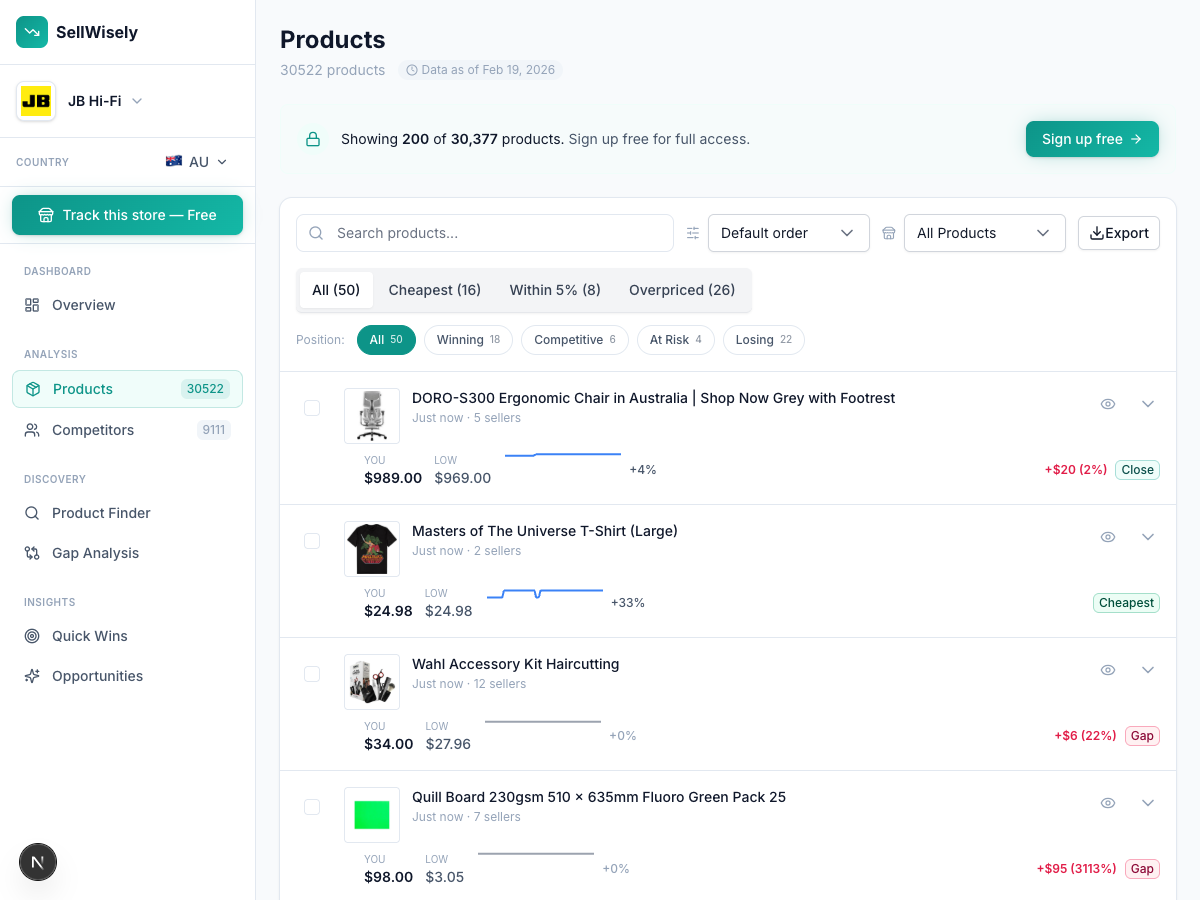
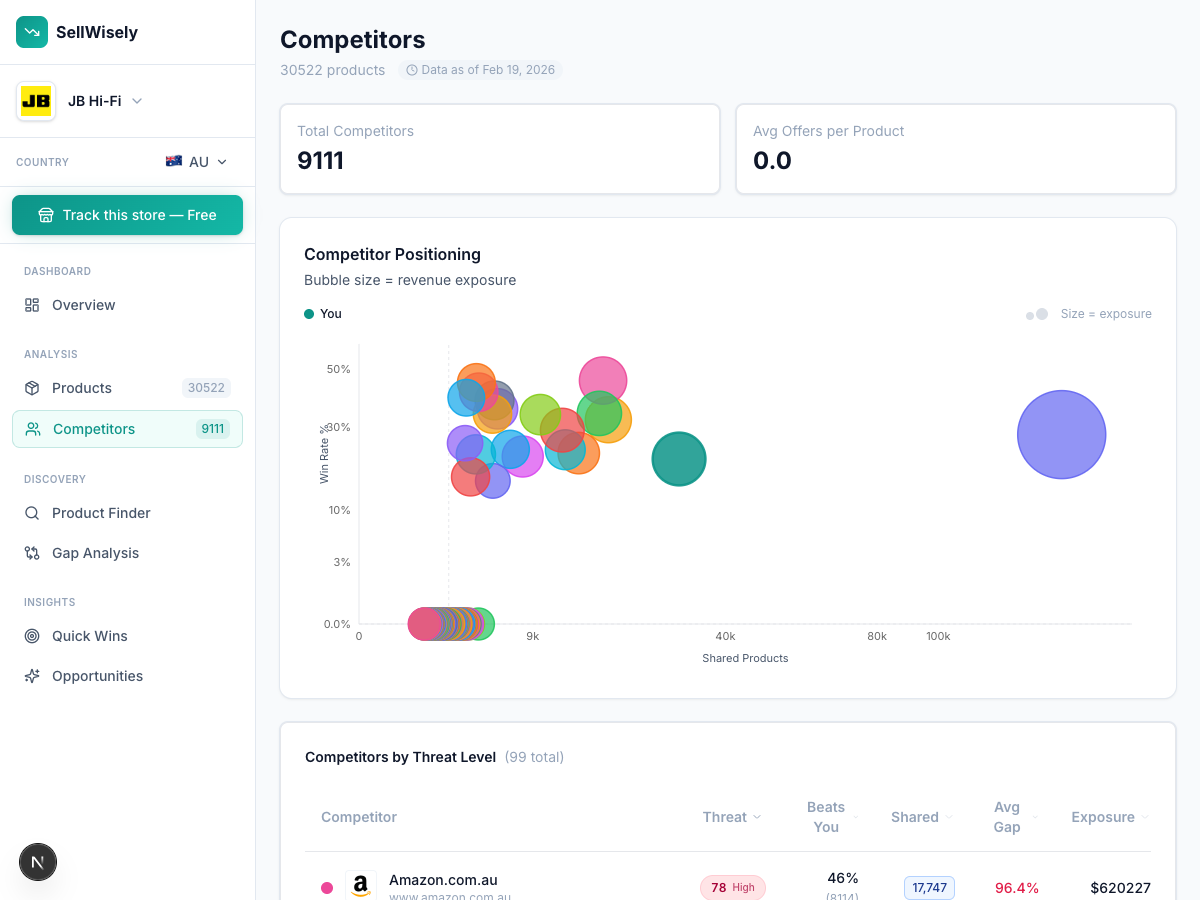
One dashboard, all channels. See your competitor's Amazon price, eBay price, and DTC website price on the same screen. Identify pricing discrepancies instantly. No tab-switching between Keepa, eBay Seller Hub, and Prisync.
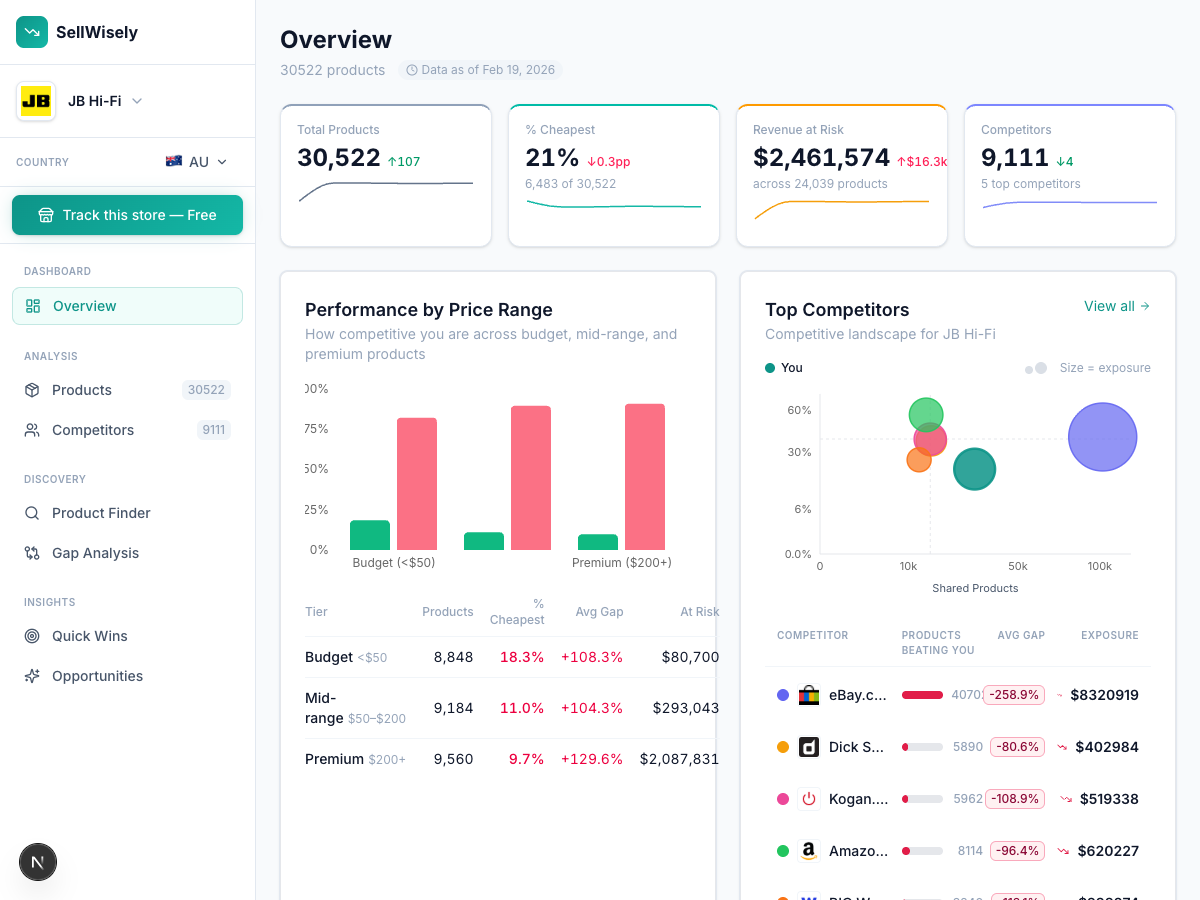
Cross-channel competitor matching. Recognize that "BrandDirect" on Amazon and "branddirect.com.au" on Shopify are the same competitor — automatically. This sounds trivial, but most single-channel tools have no concept of cross-marketplace seller identity.
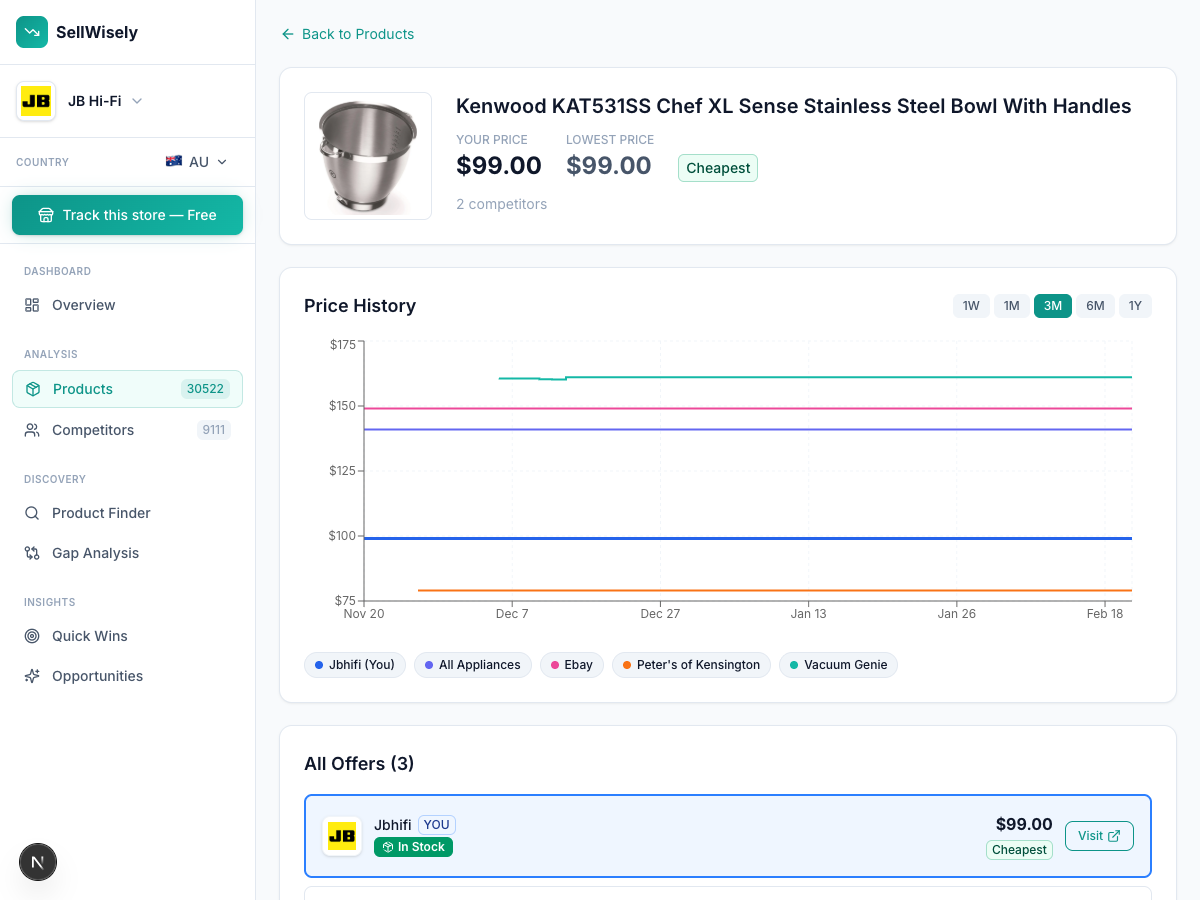
Historical data across all channels. Not just "what's the Amazon price today" but "how has this competitor priced this product across Amazon, eBay, and their website over the last 6 months?" Multi-channel price history reveals strategies that single-channel snapshots miss.
Unified alerting. "Competitor dropped price on Amazon" and "Competitor dropped price on their website" should be the same alert flow, not two separate notification systems from two different tools.
Cross-Channel Pricing Insights That Actually Matter
When you can see competitor pricing across channels simultaneously, patterns emerge that are invisible in single-channel data:
Competitors price differently across channels — on purpose. Say a competitor lists at $49 on Amazon (competitive to win the Buy Box, accepting lower margin after ~15% referral fees), $59 on their own website (higher margin, only ~3% payment processing), and $54 on eBay (middle ground, 12–13% fees). That's not inconsistency — it's a channel strategy. Understanding it helps you compete intelligently on each channel rather than assuming their Amazon price is their "real" price.
A product priced at $50 across all channels generates wildly different margins: roughly $42.50 after Amazon fees, $43.50 after eBay fees, and $48.50 on DTC. Knowing a competitor's cross-channel pricing tells you about their margin tolerance and strategic priorities.
Watch for DTC-to-marketplace leakage. When a competitor's Amazon price undercuts their own website by 15%, they're prioritizing marketplace volume over brand pricing consistency. That's a signal — they're under competitive pressure on Amazon and may not sustain those margins. You can use this intel to decide whether to match on Amazon or protect your own DTC pricing.
Some products are also priced differently across regional marketplaces due to shipping costs, import duties, or competitive intensity. Sellers who can see these cross-regional price gaps identify sourcing and arbitrage opportunities.
The Marketplace Seller's Cross-Channel Playbook
If you're selling across multiple channels, here's a practical framework for using cross-channel pricing data:
Set a pricing hierarchy. Decide which channel leads your pricing and which channels follow. Common approach: set your DTC website as the "anchor" price (highest margin), then discount for marketplaces based on their fee structure. Amazon price = DTC price minus marketplace fees minus competitive premium. This ensures profitability on every channel.
Monitor competitor channel strategies. Track whether your top 5 competitors price consistently across channels or vary by marketplace. If a competitor offers lower prices on Amazon than their website, they're using Amazon as a customer acquisition channel. If they price higher on Amazon, they're optimizing for marketplace margins. Both strategies have countermoves.
Use stock availability across channels. When a competitor goes out of stock on Amazon but still has inventory on their website, competitive pressure on Amazon drops. You may be able to hold Amazon pricing while eBay and DTC dynamics stay unchanged. Channel-specific stock data lets you adjust prices per channel, not uniformly.
Protect your DTC margins. The biggest risk of marketplace selling is margin erosion — you start matching Amazon prices on your own website because customers say "but it's cheaper on Amazon." Cross-channel monitoring helps you understand your actual competitive position on DTC (which is often different from Amazon) so you can defend margins with data, not guesswork.
Moving From Fragmented to Unified
The shift from single-channel to multi-channel price monitoring mirrors what happened with inventory management a decade ago. Sellers went from separate spreadsheets per channel to unified inventory platforms (ChannelAdvisor, Linnworks, Sellbrite) because managing stock across 4 channels in 4 systems was unsustainable.
Price monitoring is following the same trajectory. The question isn't whether you need cross-channel pricing intelligence — if you sell on multiple channels, you do. The question is whether you build it yourself (stitching together Keepa + Prisync + eBay Seller Hub + manual research) or use a platform designed for multi-channel from the start.
SellWisely tracks prices across thousands of retailers and marketplaces in a single dashboard — not just Amazon, not just one channel. If you're currently piecing together pricing data from multiple tools, it's worth seeing what unified monitoring looks like.
For a full comparison of price monitoring tools — including single-channel and multi-channel options — see our best price monitoring tools in 2026 guide.
Tired of switching between Keepa, eBay Seller Hub, and Prisync? SellWisely puts all your channels in one dashboard — free tier, no setup, no credit card.
Ready to track your competitors' prices?
Enter your store URL and see competitor prices instantly. No signup required.
Try SellWisely Free