Why Most Retailers Don't Track Competitor Prices
60-70% of retailers skip competitor price tracking entirely. The 3 barriers stopping them, what non-tracking actually costs, and what's changed in 2026.

60–70% of Small Retailers Don't Track Competitor Prices
The three reasons most retailers don't track competitor prices are: it takes too much time (150–250 hours/year manually), the tools are too complex (70% of negative reviews cite setup friction), and the cost seems too high ($99–$500+/month for SaaS tools). The 40–50% of online retailers who are owner-operators managing 5–50 SKUs are the most underserved — they can see the value but can't justify the cost-to-try.
It's not apathy. We've spent 200+ hours researching the competitive intelligence market, analyzing 1,300+ customer reviews, and profiling 82 tools in this space. The pattern is consistent: retailers who don't track competitor prices overwhelmingly say they want to. They know it matters. They just haven't found a way to do it that doesn't consume more time and money than they believe it's worth.
All three barriers are fixable — and in 2026, all three have been fixed.
The Adoption Gap 60–70% of small retailers don't track competitor prices — not because they don't care, but because the tools are too hard to set up.
Barrier 1: It Takes Too Much Time
The default method for tracking competitor prices is still, in 2026, opening competitor websites and copying numbers into a spreadsheet. Some retailers use Google Sheets with IMPORTXML formulas, which is slightly faster until the formulas break (and they break constantly — roughly 20–40% failure rate when retailers redesign their pages). If you're currently in this boat, here's how to know when you've outgrown spreadsheets.
The math on manual tracking is brutal:
- 3–5 hours per week for a typical catalog of 30–50 products
- 150–250 hours per year
- At $50/hour opportunity cost: $7,500–$12,500 per year in time spent copying numbers
The Hidden Cost of Not Tracking Manual tracking costs 150–250 hours per year — that's $7,500–$12,500 in opportunity cost.
For a micro-retailer doing $200K–$500K in revenue, that's 1.5–6% of annual revenue spent on data entry. Most people, understandably, decide their time is better spent on marketing, sourcing, or customer service.
And manual tracking doesn't scale. What works for 20 products becomes untenable at 50. By 100 products, you'd need a part-time employee just to keep the spreadsheet current. The DIY Micro-Retailer — an owner-operator managing 5–50 SKUs — is the most underserved persona in the pricing intelligence market, representing roughly 40–50% of online retailers.
These aren't people who can't see the value of competitive pricing data. They're people making a rational time-allocation decision with the options available to them.
Barrier 2: The Tools Are Too Complex
The natural upgrade path from spreadsheets is a dedicated SaaS tool. Products like Prisync, Price2Spy, and Netrivals have been around for a decade. They work. But they share a common problem: setup friction.
Every traditional price monitoring SaaS requires you to:
- Create a CSV file mapping your products to competitor URLs
- Figure out the tool's import format (each one is different)
- Upload the CSV and wait for initial data collection
- Discover that 10–20% of your URLs don't work
- Manually troubleshoot and fix broken mappings
- Maintain this configuration as products change
We found that setup friction is mentioned in 70% of negative reviews across the top price monitoring platforms. Real quotes from Capterra reviews:
"Initial setup was a lot of work."
"Setup is very complicated, especially CSV mapping."
"Can't upload products ourselves, must go through support."
"Onboarding products is the most time-consuming aspect."
Setup Is the #1 Barrier 70% of negative reviews across price monitoring tools cite setup friction as the primary complaint.
The expectation gap is significant. Retailers expect to see competitor data within 10 minutes of signing up. Most tools deliver first data in 24–48 hours at best. Some enterprise platforms take 60–180 days to onboard.
This isn't a complaint about any single tool. It's a structural problem with how the entire category works. When the setup experience is painful enough to generate the majority of negative reviews, the issue is architectural, not UI-level.
Barrier 3: It Costs Too Much
Price monitoring tools fall into two cost buckets, and neither works for the typical small retailer.
SMB SaaS tools:
| Tool | Starting Price | Free Tier |
|---|---|---|
| Prisync | $99/month | 14-day trial only |
| Price2Spy | $40/month | 14-day trial only |
| Netrivals | ~$100–$500/month | Trial only |
| Omnia Retail | $1,000+/month | None |
Enterprise tools:
| Tool | Annual Cost |
|---|---|
| Intelligence Node | $60,000–$500,000 |
| Competera | $500,000–$2,000,000 |
| Skuuudle | $10,000–$1,000,000+ |
For a retailer doing $200K in revenue, even $99/month ($1,188/year) needs to demonstrate clear ROI. And here's the catch: you can't demonstrate ROI without trying the tool, but the 14-day trial often isn't enough time because you're spending half of it fighting setup friction.
The result is a vicious cycle. Retailers sign up for a trial, struggle with CSV setup, run out of trial days before seeing meaningful data, and conclude that competitor tracking isn't worth the hassle. They're not wrong about the hassle. They're wrong about the tracking.
DIY automation (n8n, Browse AI, Apify) looks cheaper — $55–$270/month all-in — but requires 10–20 hours of initial setup and 12–36 hours per year of maintenance. For non-technical retailers, that's not a real option.
Why Track Competitor Prices: The Data Behind the Decision
The barriers are real and understandable. But the cost of not tracking is real too, even if it's harder to see.
You miss pricing opportunities when competitors go out of stock. If your competitor runs out of a popular item, you could hold or raise your price on the same product. Without monitoring, you'll never know the opportunity existed.
Margin erosion happens gradually. A competitor drops their price by 2%. Then another 3% the next month. You don't notice because you're not checking. Six months later, you've lost price-sensitive customers to a competitor who's now 8% cheaper, and you have no idea why sales dipped. Our analysis of pricing data from 10,000+ retailers shows this pattern plays out across every retail category.
You can't time promotions effectively. Retailers who track competitor pricing over time discover seasonal patterns — competitors tend to discount at predictable intervals. Without this data, your promotional calendar is based on gut feel rather than competitive reality.
You leave catalog expansion revenue on the table. If you don't know what products your competitors sell that you don't, you can't make informed stocking decisions. Gap analysis — identifying products in your competitors' catalogs that are absent from yours — is one of the highest-value uses of competitive intelligence.
One data point makes this concrete. Justtools, an Australian power tools retailer, reported saving 30–40 hours per week and increasing monthly revenue by $18,000 AUD after adopting price monitoring. That translates to roughly $300,000 in annual revenue that was previously being left on the table — a 38x return on their $119/month subscription.
Real-World Impact Justtools reported $18K AUD/month in additional revenue after adopting automated price monitoring — a 38x ROI.
Not every retailer will see 38x ROI. But the gap between "tracking" and "not tracking" is almost always larger than the gap between tracking tools.
What Changed in 2026
The three barriers — time, complexity, and cost — persisted for a decade because they were structural. Every price monitoring tool was built on the same architecture: the user tells the system what to track, the system scrapes those specific URLs, and the user pays for the number of products monitored.
The pre-collected data model breaks this cycle.
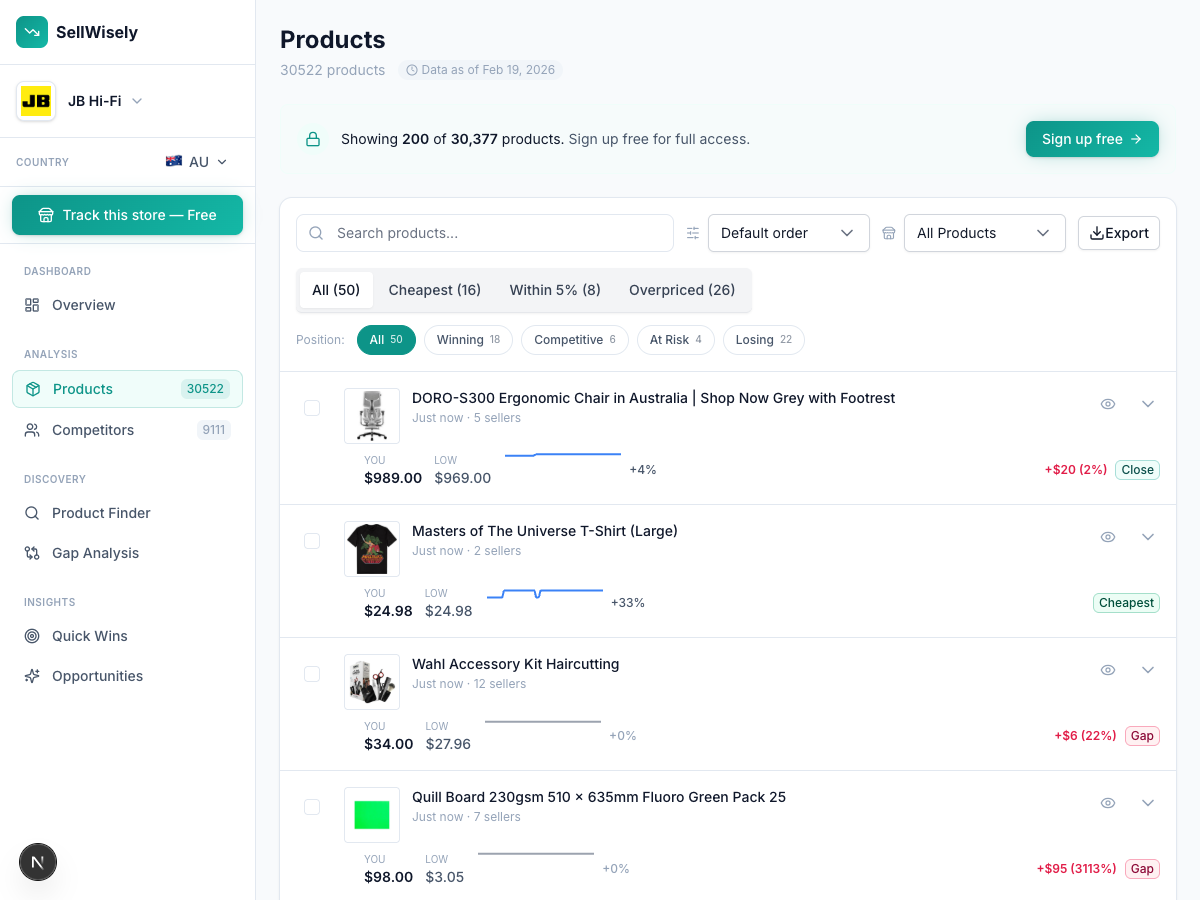
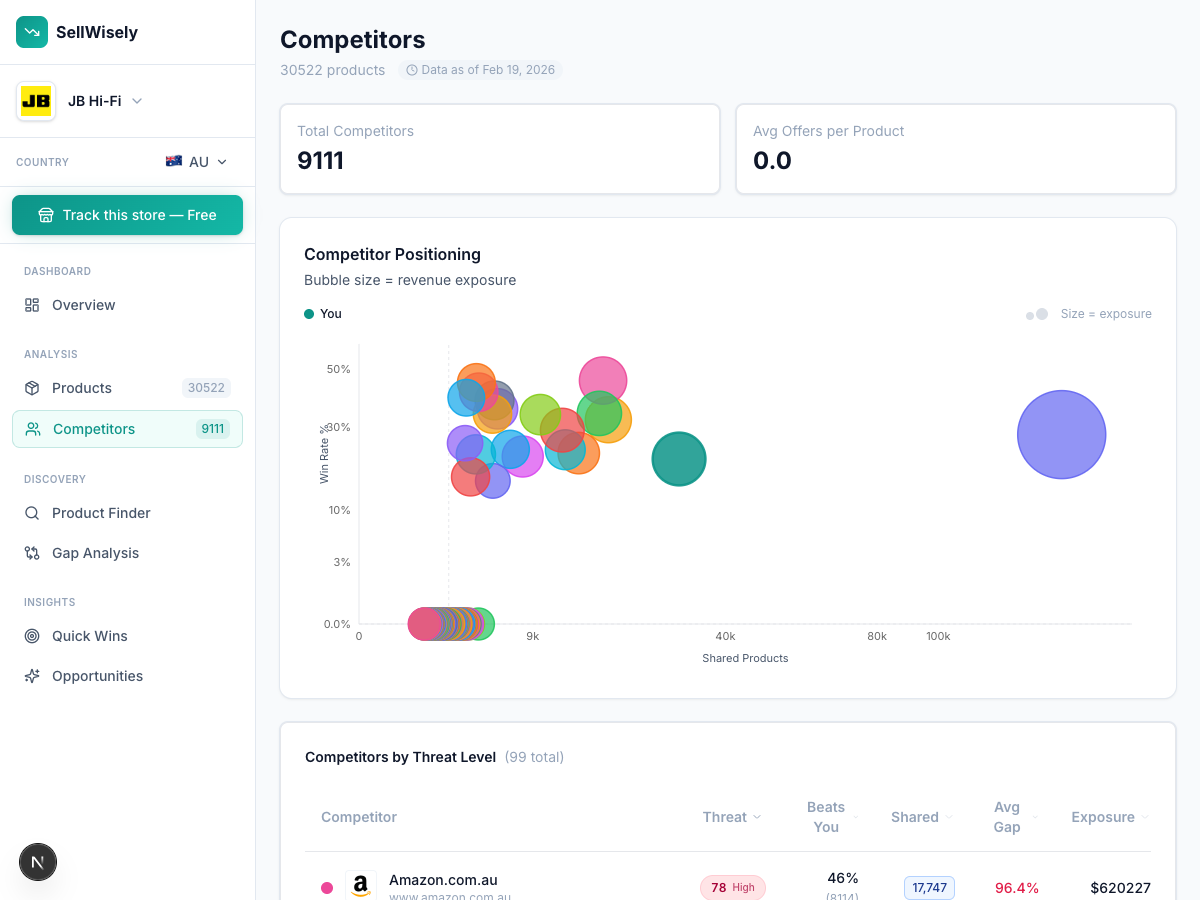
Instead of scraping on demand after you sign up, platforms like SellWisely collect pricing data from thousands of retailers continuously, before you create an account. When you sign up and enter your store URL, the data already exists. There's no CSV mapping because the platform already knows which products exist across which retailers. There's no maintenance because scraper fixes happen once, for all users, not per-customer.
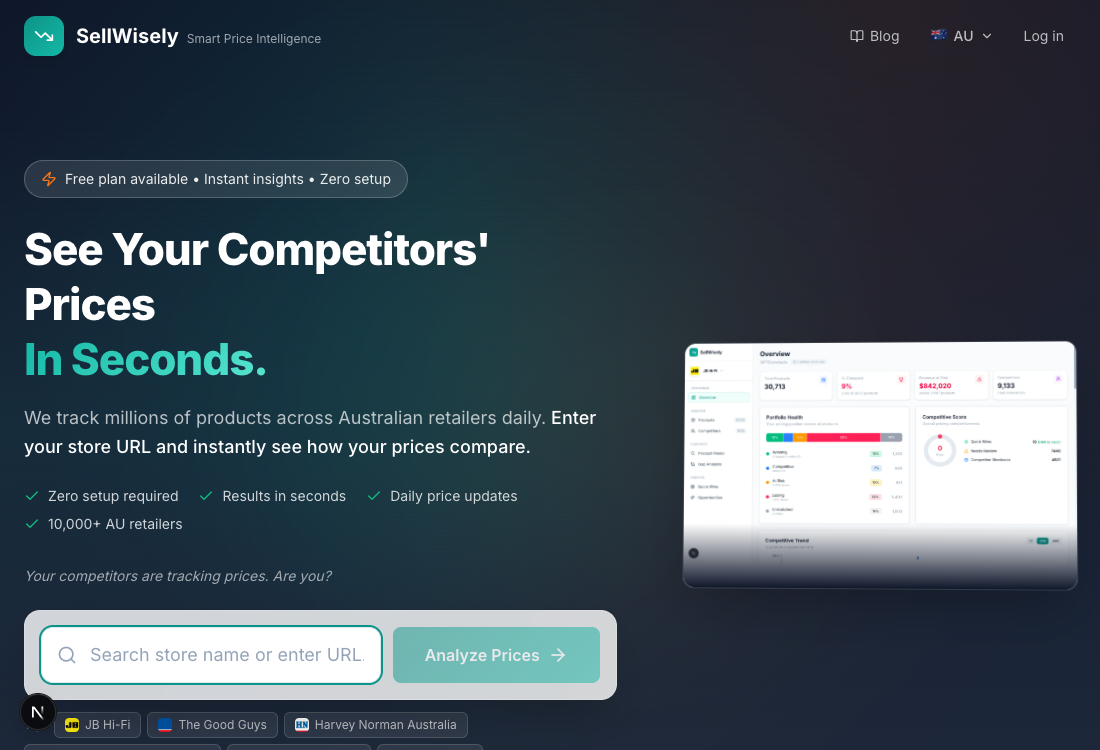
The pre-collected model addresses all three at once. Setup drops from hours to seconds because you enter a URL instead of building a CSV. Product matching happens automatically across 10,000+ retailers — no URL mapping, no competitor configuration. And SellWisely offers a forever-free tier, not a 14-day trial, so you can validate whether competitor tracking is actually worth it before spending anything. Paid plans start at $99/month when you're ready to scale.
The forever-free tier matters more than most people realize. The biggest group of non-trackers aren't people who tried and rejected price monitoring. They're people who never tried at all because the cost-to-try was too high. When the cost drops to zero and the time investment drops to 10 seconds, the decision math changes completely.
How to Start Tracking With Zero Investment
If you're in the 60–70% who don't currently track competitor prices, here's the lowest-friction path to getting started:
Step 1: Go to SellWisely and enter your store URL. You'll see which competitors sell the same products you do, and what they charge. This takes about 10 seconds.
Step 2: Spend 5 minutes looking at the data. Are any of your prices significantly higher or lower than competitors? Are there competitors you didn't know about? Are there products you're missing?
Step 3: Decide if the data is useful. If it is, you've just gone from "no competitor tracking" to "competitor tracking" with zero cost and 10 seconds of effort. If it's not useful for your specific category, you've lost nothing.
That's it. No commitment, no configuration, no credit card.
For a deeper look at all four methods for tracking competitor prices — from spreadsheets to pre-collected data platforms — read our complete guide to competitor price tracking.
Still in the 60–70%? Enter your store URL into SellWisely — 10 seconds, zero cost, and you'll know immediately whether competitor data is useful for your business.
Ready to track your competitors' prices?
Enter your store URL and see competitor prices instantly. No signup required.
Try SellWisely Free