Zero-Setup Price Monitoring With Pre-Collected Data
Price monitoring with no setup required. How pre-collected data eliminates the setup friction that stops most retailers from tracking competitor prices.
Why Automated Price Monitoring Beats Manual Setup
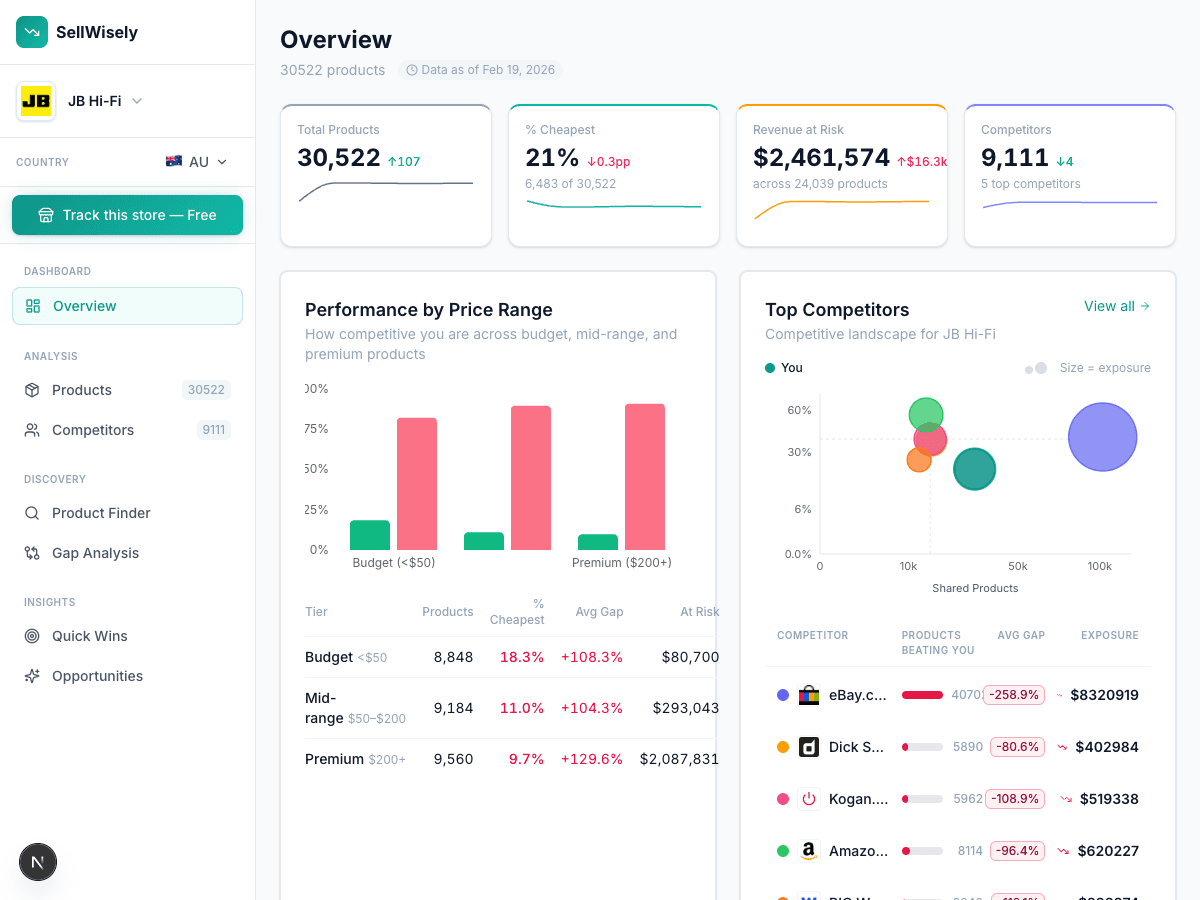
Zero-setup price monitoring uses pre-collected data — pricing information already gathered from thousands of retailers before you sign up — to deliver instant competitor insights without CSV uploads, URL mapping, or configuration. You enter your store URL and see competitor prices in seconds, not hours.
Every other competitor price monitoring tool on the market asks you the same question on day one: What do you want to track?
You upload a CSV of your products. You enter competitor URLs. You configure matching rules. You wait for the first crawl. A few hours later — if everything goes right — you see your first data.
This workflow hasn't changed since Prisync launched in 2013. Price2Spy, Netrivals, Omnia, Competera, Intelligence Node — every major B2B price monitoring SaaS follows the same pattern: user configures, tool collects.
It works. But there's a problem.
Setup Is the #1 Adoption Killer
We analyzed 1,300+ customer reviews across 12 price monitoring tools. Setup friction appeared in 70% of negative reviews — across Prisync, Price2Spy, Netrivals, Omnia, and Browse AI. It wasn't a niche complaint. It was the dominant one.
"Initial setup was a lot of work." "Setup is very complicated, especially CSV mapping." "Can't upload products ourselves, must go through support." "Onboarding products is the most time-consuming aspect."
These aren't reviews from bad tools. Prisync has 4.8/5 on Capterra. Price2Spy has 5.0/5 for support quality. Customers like these products once they're past setup. But many never get past setup.
The number that should concern anyone in this space: 60–70% of small retailers don't monitor competitor prices at all.
The Adoption Gap 60–70% of small retailers don't monitor competitor prices — not because they don't care, but because setup friction stops them.
Not because they don't care. Not because they can't afford it. Because the effort of getting started exceeds the perceived value — at least until they've actually experienced what automated price intelligence feels like.
The industry has a massive non-consumption problem, and the entire category has been ignoring the root cause. Setup friction doesn't just make the product harder to use. It prevents the product from being used at all.
The Pre-Collected Data Model
Think about how SEO tools work. When you sign up for Ahrefs or SEMrush, you don't upload your backlink profile. You don't tell it which keywords to track. You enter a domain, and the tool already knows your backlinks, your rankings, your organic traffic estimates — because it's been collecting that data continuously, for years, regardless of whether you had an account.
That's the pre-collected data model. The data exists before the user shows up.
Apply this to price monitoring: What if a platform already knew the prices of 5 million products across 10,000+ retailers? What if it had 3 years of pricing history already stored? What if, when you entered your store URL, it instantly matched your products against that database and showed you who else sells them and at what price?
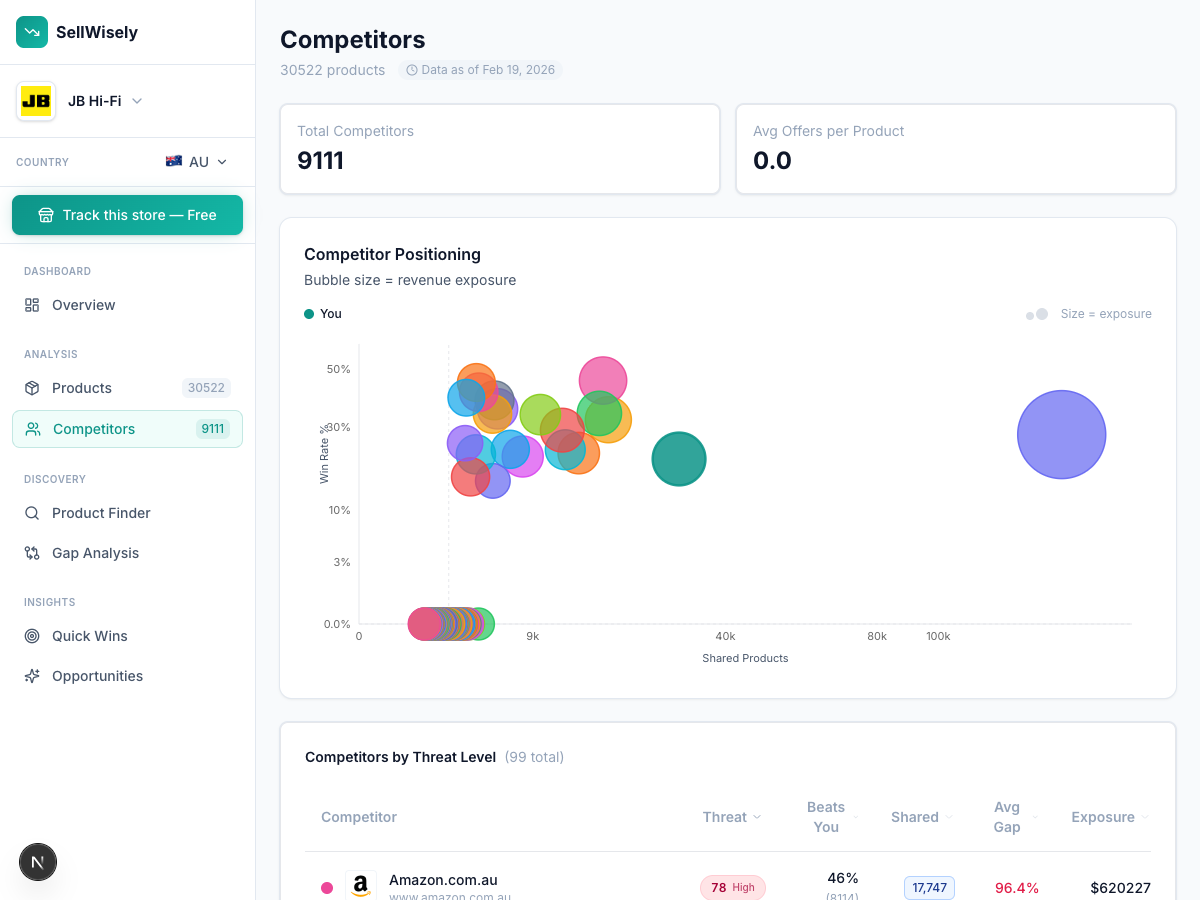
That's how SellWisely works. No CSV upload. No URL hunting. No "wait for first crawl." Enter your store URL, and the data is there. Ten seconds from signup to seeing competitor prices.
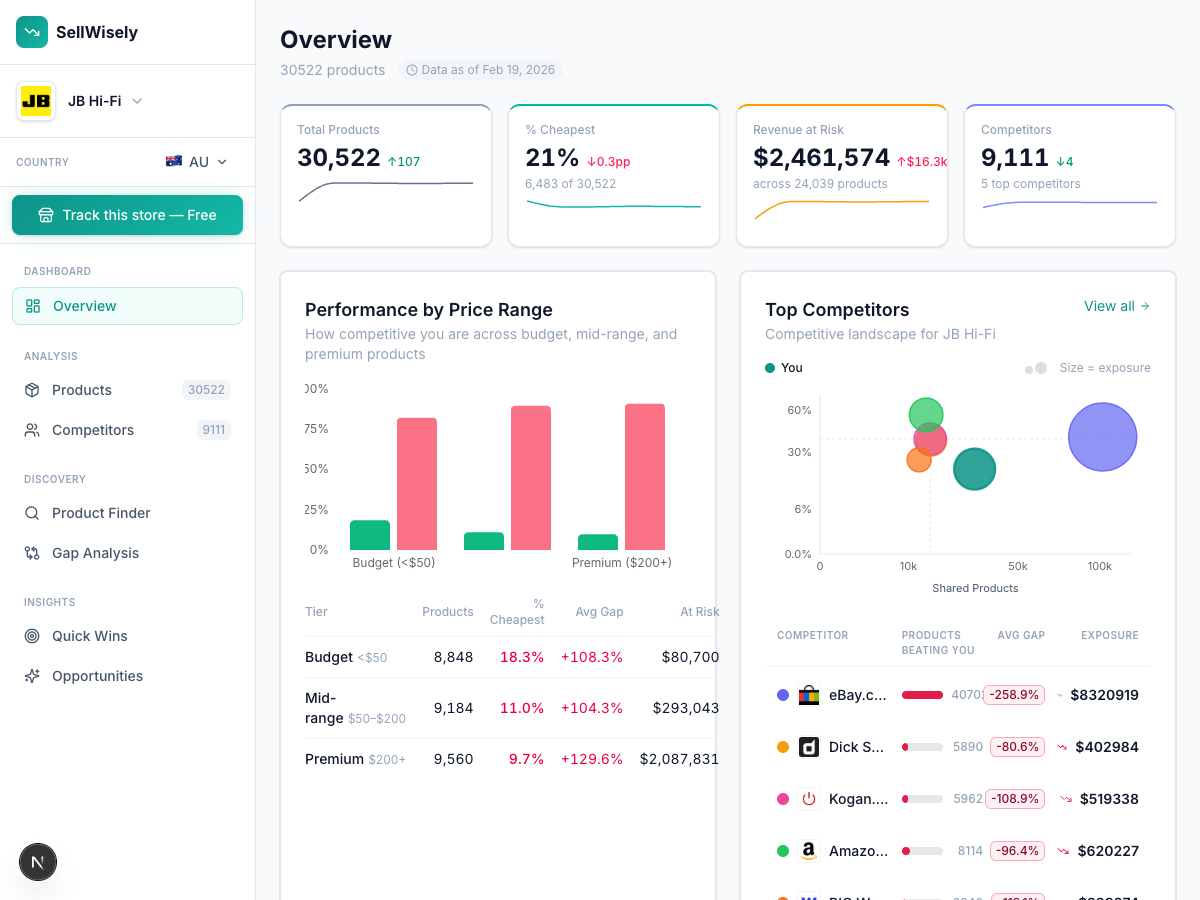
10 Seconds to First Data From signup to seeing your first competitor prices: 10 seconds. No CSV uploads, no URL mapping, no waiting for crawlers.
This isn't a feature improvement. It's a different architecture.
| Configure-First (Prisync, Price2Spy) | Pre-Collected (SellWisely) | |
|---|---|---|
| Setup time | Hours to days (CSV mapping, URL entry) | Seconds (enter store URL) |
| Historical data | Starts from signup date | 3 years available immediately |
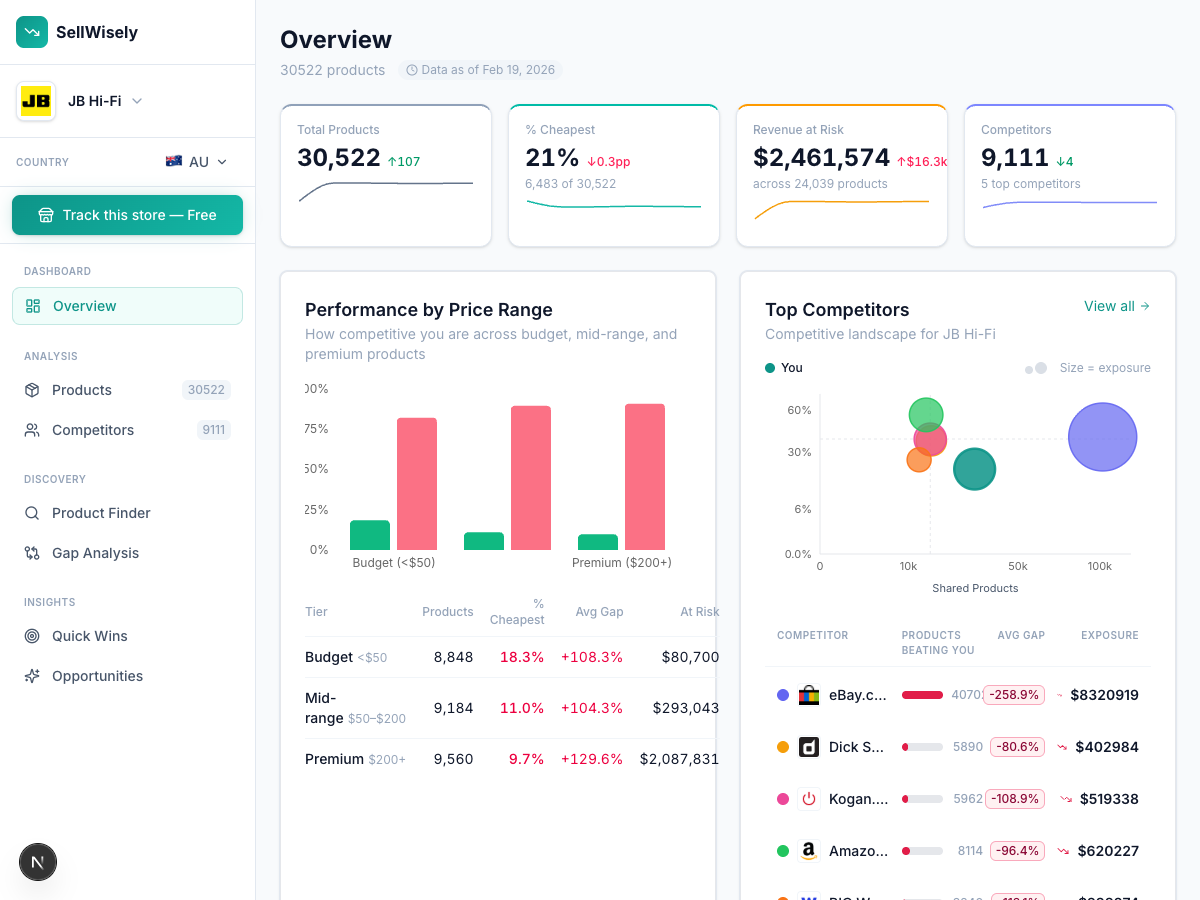
| Competitor discovery | Only tracks URLs you add | Surfaces competitors automatically |
| Product gap analysis | Not possible (only knows your uploads) | Built-in (millions of products mapped) |
| Maintenance | Ongoing URL updates as competitors change | None — data collection is handled |
| Coverage | Any URL you configure | Limited to pre-indexed retailers |
| Custom competitors | Yes — add any URL | Only retailers in database |
Both models have clear tradeoffs. Configure-first gives you full control over exactly what gets tracked. Pre-collected gives you breadth and instant access at the cost of coverage flexibility.
What This Makes Possible
The difference between configure-first and pre-collected isn't just about convenience. It unlocks capabilities that are impossible in the traditional model.
Historical Data From Before You Signed Up
Traditional tools start collecting when you create an account. Your price history is blank until that moment. A pre-collected platform has years of data waiting for you. Want to see how a competitor priced their products last Black Friday? Last EOFY? Two years ago? That analysis is available on day one.
Competitor Discovery
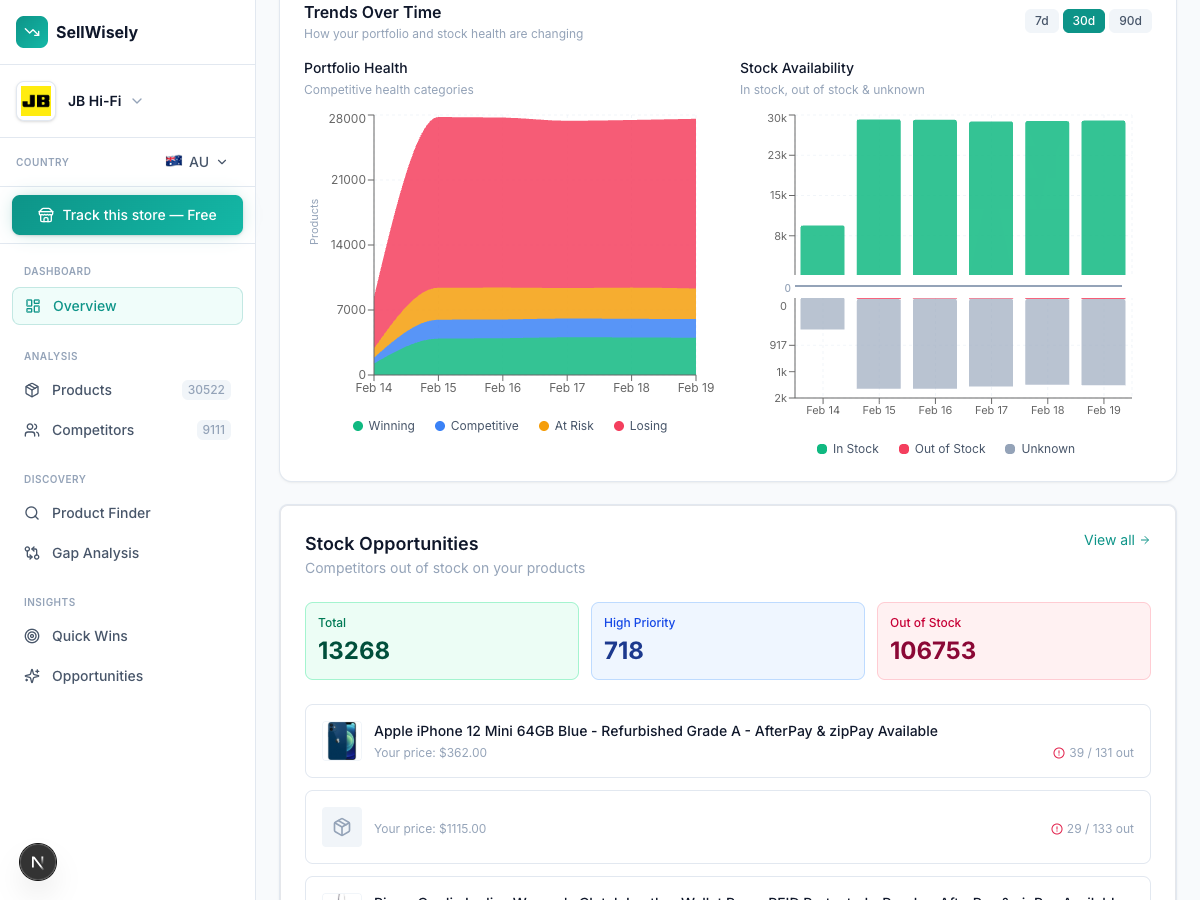
Configure-first tools only track competitors you already know about. You specify URLs. If you don't know a competitor exists, they're invisible. Pre-collected platforms can tell you: "Here are 23 retailers selling this same product. You knew about 8 of them." Finding competitors you didn't know existed is a material revenue opportunity — it surfaces gaps in your market awareness.
Product Gap Analysis
With millions of products already mapped, a pre-collected platform can show you products your competitors sell that you don't carry. This goes beyond price tracking into catalog strategy — a category of intelligence that configure-first tools can't provide because they only know about the products you've uploaded.
True Zero-Setup Experience
If setup takes 10 seconds instead of 10 hours, the calculus changes completely. The 60–70% of retailers who don't track competitors? The barrier that stopped them no longer exists.
Why This Approach Is Rare
If pre-collected data is so much better for the user experience, why doesn't every price monitoring tool offer it? The short answer: it's expensive and slow to build, and most tools are already profitable with the configure-first model.
It requires years of data collection up front. SellWisely's data comes from BuyWisely, which has been collecting pricing data from Australian retailers since 2022. Three years of continuous scraping, product matching, and data normalization — all before the first SellWisely user signed up.
Cross-retailer product matching is hard. Keepa makes the pre-collected model work for Amazon because Amazon provides clean product identifiers (ASINs). Matching "Samsung Galaxy S24 Ultra 256GB Titanium Gray" on one site to "SAMSUNG S24Ultra 256g Grey" on another requires ML models trained on millions of product pairs. This is the part that determines whether the data is actually useful to you as a store owner — bad matching means bad competitor data.
Most tools charge per product, which makes pre-collection uneconomical. Prisync's tiers are based on 100, 1,000, or 5,000 products. Collecting data on millions of products proactively — before anyone pays for them — doesn't work with per-product pricing.
Keepa is the only other platform that's built a pre-collected model successfully, but it covers Amazon only. For cross-retailer monitoring, pre-collected data is still new territory.
What This Means for the Market
The configure-first model dominated because it was the only economically viable approach when the category started. Tools like Prisync built successful businesses — $6.6M in annual revenue, 600+ customers — on the strength of their execution within that model.
Prisync's Paradox Prisync earns $6.6M in revenue with 600+ customers — but 70% of negative reviews cite the very setup process that defines their product.
But the 60–70% non-consumption rate tells us something: the category has been serving the minority of retailers who are willing to invest setup time, while leaving the majority behind. The retailers who most need competitive intelligence — small operators flying blind on pricing — are the same ones who can't justify a multi-hour setup process.
Pre-collected data doesn't replace configure-first tools for every use case. If you need to track a specific niche competitor, want repricing automation, or need to verify that prices are current within hours rather than a day, established tools like Prisync remain strong choices. Data freshness is the main tradeoff — pre-collected platforms update daily, which is fine for strategic pricing but won't catch a competitor's flash sale in real time. (We wrote a detailed comparison of the options available.)
But for the vast majority of retailers — the ones asking "am I priced right?" and "who else sells what I sell?" — pre-collected data removes the friction that's been keeping them in the dark.
That shift — from "tell us what to track" to "we already know" — is what makes price monitoring accessible to the 60–70% who've never used a tool. The same shift happened in SEO when Ahrefs started indexing the web proactively. It was overdue in price monitoring.
For a practical guide on how to get started — whether with manual methods, DIY automation, or pre-collected platforms — see our complete guide to tracking competitor prices.
Want to see the difference for yourself? Enter your store URL on SellWisely and you'll have competitor prices before you finish reading this sentence. Free, no credit card, no CSV.
Ready to track your competitors' prices?
Enter your store URL and see competitor prices instantly. No signup required.
Try SellWisely Free